Crochet Frog Ballerina Amigurumi — Free Pattern
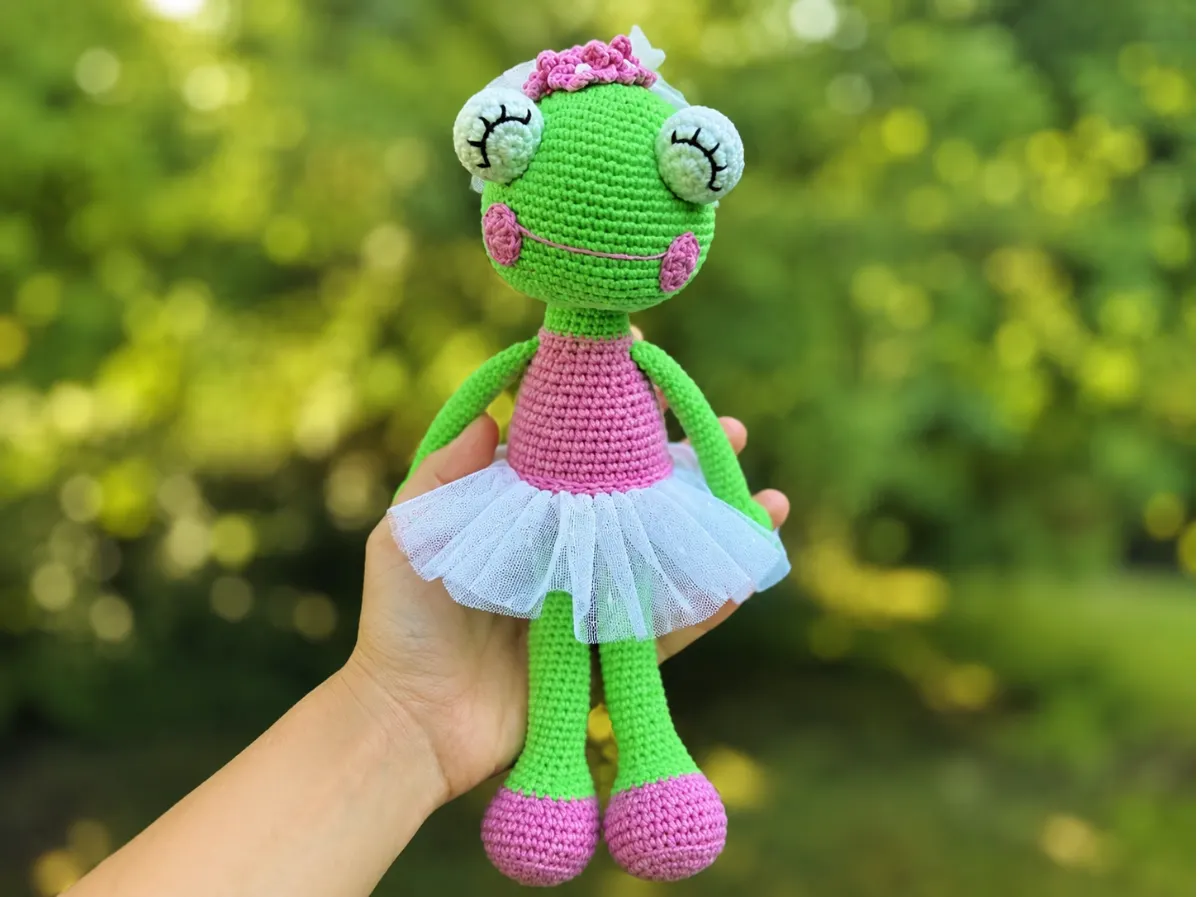
This crochet frog ballerina has been sitting on my desk as I tested her, and I keep catching myself looking over at her. She is 10.6 inches of very deliberate construction — embroidered eyelashes, a crown of tiny five-petal flowers, a color-blocked body with a built-in waistband, and legs that took me three tries to get right. If you love a crochet frog project with real personality, this is it. Every stitch count has been checked. Let’s get into it.
📋 Pattern Quick Stats
- Difficulty: Intermediate
- Finished Size: 10.6 in (27 cm)
- Hook Size: 2.0mm (Steel 4)
- Yarn Weight: Fingering / Lace (CYCA 0–1) — fine cotton recommended
- Techniques: magic ring, invisible decrease, color changes, BLO, double crochet, embroidery, multi-part assembly
- Estimated Time: 10–14 hours
Materials for This Crochet Frog Ballerina Pattern
Because this pattern uses a 2.0mm steel hook, yarn weight matters more than usual. I strongly recommend fine mercerized cotton in both colors. It behaves beautifully at tight tension, gives you sharp stitch definition, and the finished fabric is dense enough that no stuffing shows through — which is exactly what you want when making a piece this detailed.
- Green yarn — fine cotton, fingering or lace weight (CYCA 0–1). This is your main color for the head, eyes, arms, and upper legs.
- Pink yarn — matching weight and fiber. Used for the body bodice, cheeks, decorative flowers, and lower legs / foot shaping.
- Hook: 2.0mm (Steel 4). This is a steel crochet hook — not a standard aluminum hook. Check the Craft Yarn Council hook size chart if you’re converting from a different size system.
- Polyfill stuffing — I use Poly-Fil by Fairfield, available at Joann, Michaels, and Hobby Lobby. Stuff firmly.
- Tulle or lightweight fabric — for the gathered skirt. About 12–15 in of narrow tulle ribbon works well, or cut a strip from a larger piece.
- 5 small white beads — for the centers of the decorative flowers.
- Black embroidery thread — for the eyelashes.
- Pink embroidery thread or thin pink yarn — for the mouth.
- Tapestry needle — for sewing all parts together and weaving in ends.
- Stitch marker — non-negotiable. You are working in continuous rounds and this pattern has a lot of them.
💡 Emma’s Tip: If you’re unsure which yarn weight to buy, look for anything labeled “fingering” or “sock weight” with a recommended hook in the 1.5–2.5mm range. Fine mercerized cotton gives the best result here — acrylic at this weight tends to be slippery and harder to control.
Abbreviations Used in This Crochet Frog Pattern
| Abbreviation | Meaning |
|---|---|
| mr | magic ring (adjustable loop start) |
| ch | chain |
| sl st | slip stitch |
| sc | single crochet |
| dc | double crochet |
| inc | increase — 2 single crochets worked into the same stitch |
| dec | decrease — worked as invisible decrease throughout (see note below) |
| BLO | back loop only — insert hook through the back loop of the stitch only |
⚠️ Important — Decrease Method: Wherever this pattern says dec, work it as the invisible decrease: insert your hook through the front loops only of the next two stitches simultaneously, yarn over, pull through, yarn over, pull through both loops. This eliminates the gap you get with the standard method and keeps your fabric clean — especially important on a piece this large. If you need a walkthrough, our complete invisible decrease tutorial covers it step by step.
Special Techniques for This Crochet Frog Pattern
Before you start, I’d recommend being comfortable with the following. Each one gets used multiple times across this pattern, and being confident with them will save you a lot of frogging.
- Magic Ring: Every part of this pattern starts with one. If yours still has a hole in the center, check out our step-by-step magic ring tutorial and practice on scrap yarn before beginning.
- Invisible Decrease: Used extensively in the head, eyes, arms, and legs. Work through front loops only — always. See the abbreviation note above.
- BLO (Back Loop Only): Used twice in this pattern — on the legs (Row 5) and on the body (Rows 12 and 26). The BLO row on the body is what creates the ridge that holds the skirt waistband in place. Don’t skip it.
- Color Changes: The body switches from pink to green at Row 26. The legs switch from pink to green at Row 11. If you’re not confident with seamless color changes, our color change tutorial will walk you through the technique.
- Multi-Part Assembly: This frog has 7 individual parts plus the skirt and embroidery. Take your time with placement before you sew anything down. Our guide to sewing amigurumi parts together has pinning tips that are genuinely useful for a project this complex.
Crochet Frog Ballerina Pattern
Head (Make 1) — Green
Start with a magic ring. Work in continuous rounds.
Row 1: 6 sc in mr (6)
Row 2: (inc) × 6 (12)
Row 3: (sc, inc) × 6 (18)
Row 4: (2 sc, inc) × 6 (24)
Row 5: (3 sc, inc) × 6 (30)
Row 6: (4 sc, inc) × 6 (36)
Row 7: (5 sc, inc) × 6 (42)
Row 8: (6 sc, inc) × 6 (48)
Row 9: (7 sc, inc) × 6 (54)
Row 10: (8 sc, inc) × 6 (60)
Rows 11–23: 60 sc (13 rounds) (60)
Row 24: (8 sc, dec) × 6 (54)
Row 25: (7 sc, dec) × 6 (48)
Row 26: (6 sc, dec) × 6 (42)
Row 27: (5 sc, dec) × 6 (36)
Row 28: (4 sc, dec) × 6 (30)
Row 29: (3 sc, dec) × 6 (24)
Row 30: (2 sc, dec) × 6 (18)
Row 31: (sc, dec) × 6 (12)
Row 32: (dec) × 6 (6)
💡 Emma’s Tip: Begin stuffing the head firmly around Row 24, before the opening gets too narrow. I always overstuff slightly at first, then adjust as I close. The head needs to feel solid — she’s carrying a headpiece, and a soft head will sink.
Eyes (Make 2) — Green
Start with a magic ring. Work in continuous rounds.
Row 1: 6 sc in mr (6)
Row 2: (inc) × 6 (12)
Row 3: (sc, inc) × 6 (18)
Rows 4–6: 18 sc (3 rounds) (18)
Row 7: (sc, dec) × 6 (12)
Row 8: (dec) × 6 (6)
💡 Emma’s Tip: These eyes are small and close up quickly. Stuff them firmly before you get past Row 7 — once the opening is at 12 stitches, it’s tight. I use a pencil to pack the stuffing in rather than my fingers. Close the opening and leave a long tail for sewing. The eyelashes are embroidered directly onto the finished eyes before they are attached to the head.
Cheeks (Make 2) — Pink
Start with a magic ring. These are worked flat.
Row 1: 12 dc in mr (12)
Fasten off, leaving a tail for sewing. Pull the magic ring closed tightly before you do anything else — a gap in the center of the cheek will be visible once it’s attached to the face.
Decorative Flowers (Make 5) — Pink
Start with a magic ring. These are worked flat with five petals.
Row 1: In mr: (2 ch, dc, 2 ch, sl st) × 5 — 5 petals total
Fasten off, leaving a tail for attaching to the head. Pull the ring closed snugly. Sew one white bead into the center of each finished flower before you attach them to the headpiece.
💡 Emma’s Tip: Make all five flowers before you attach any of them. Lay them out together with the tulle and decide on your arrangement first — it’s much easier to adjust placement when nothing is sewn down yet.
Body (Make 1) — Pink / Green
Start with a magic ring in pink. Work in continuous rounds.
Row 1: 6 sc in mr [pink] (6)
Row 2: (inc) × 6 [pink] (12)
Row 3: (sc, inc) × 6 [pink] (18)
Row 4: (2 sc, inc) × 6 [pink] (24)
Row 5: (3 sc, inc) × 6 [pink] (30)
Row 6: (4 sc, inc) × 6 [pink] (36)
Row 7: (5 sc, inc) × 6 [pink] (42)
Rows 8–11: 42 sc (4 rounds) [pink] (42)
Row 12: BLO 42 sc [pink] (42)
Rows 13–17: 42 sc (5 rounds) [pink] (42)
Row 18: (5 sc, dec) × 6 [pink] (36)
Rows 19–20: 36 sc (2 rounds) [pink] (36)
Row 21: (4 sc, dec) × 6 [pink] (30)
Rows 22–23: 30 sc (2 rounds) [pink] (30)
Row 24: (3 sc, dec) × 6 [pink] (24)
Row 25: 24 sc [pink] (24)
Row 26: BLO 24 sc [green] (24)
Rows 27–30: 24 sc (4 rounds) [green] (24)
⚠️ Row 12 — BLO Note: Do not skip the BLO on Row 12. The free front loops left behind from this row are where you will later attach the skirt waistband. After the body is complete and stuffed, return to those free front loops and work 42 dc around the entire row to create the waistband. The skirt attaches behind this dc band.
⚠️ Color Change — Row 26: Switch to green before beginning Row 26. Work Row 26 in BLO with green yarn. This creates a clean color transition at the waist and leaves a subtle ridge.
💡 Emma’s Tip: Stuff the body firmly and continuously as you work the upper section. I find this body closes at a narrow 24-stitch opening — get your stuffing in before Row 27 or it becomes difficult to distribute evenly.
Arms (Make 2) — Green
Start with a magic ring. Work in continuous rounds.
Row 1: 6 sc in mr (6)
Row 2: (inc) × 6 (12)
Row 3: (sc, inc) × 6 (18)
Rows 4–7: 18 sc (4 rounds) (18)
Row 8: (sc, dec) × 6 (12)
Row 9: (4 sc, dec) × 2 (10)
Rows 10–30: 10 sc (21 rounds) (10)
Finishing: Fold the arm flat and work 5 sc through both layers to close the opening. Do not stuff the arm tubes — they should remain flat and flexible for posing.
💡 Emma’s Tip: Rows 10–30 are 21 identical rounds of 10 sc. Put on something to listen to and just count. I mark every 5th round on a sticky note — it’s a long tube and it’s easy to lose track.
Legs (Make 2) — Pink / Green
These start with a foundation chain rather than a magic ring — this is how the foot shape is constructed.
Begin with 6 ch in pink.
Row 1: Starting in 2nd ch from hook: 4 sc, 3 sc in one st, 3 sc, inc [pink] (12)
Row 2: inc, 3 sc, 3 inc, 3 sc, 2 inc [pink] (18)
Row 3: inc, 6 sc, 2 inc, 6 sc, inc, 2 sc [pink] (22)
Row 4: sc, inc, 6 sc, 5 inc, 6 sc, 2 inc, sc [pink] (30)
Row 5: BLO 30 sc [pink] (30)
Rows 6–8: 30 sc (3 rounds) [pink] (30)
Row 9: 9 sc, (dec, sc) × 4, 9 sc [pink] (26)
Row 10: 7 sc, (dec, sc) × 4, 7 sc [pink] (22)
Row 11: 22 sc [green] (22)
Row 12: 8 sc, (dec, sc) × 2, 8 sc [green] (20)
Row 13: 8 sc, 2 dec, 8 sc [green] (18)
Row 14: 18 sc [green] (18)
Row 15: (4 sc, dec) × 3 [green] (15)
Rows 16–40: 15 sc (25 rounds) [green] (15)
⚠️ Color Change — Row 11: Switch to green before beginning Row 11. The transition happens at the ankle, right where the foot shape ends. A clean change here makes the leg look polished.
Finishing: Fold the leg flat, skip 1 stitch, and work 7 sc through both layers to close the opening. Stuff the foot section firmly. The upper tube can be lightly stuffed or left soft depending on how you want the legs to hang.
💡 Emma’s Tip: Rows 16–40 are 25 rounds of 15 sc. This is the longest tube in the whole pattern. I make both legs at the same time — not literally, but I alternate between them every 5 rounds to keep them identical in length and tension. It also breaks up the monotony.
Assembly
- Prepare all parts. Weave in all ends before you begin assembly. You do not want to be doing that with parts already attached to each other.
- Attach the eyes to the head. Position the eyes on the upper half of the head, symmetrically on each side. Pin them and check the placement from the front, side, and slightly above before sewing. The eyes sit as protruding bumps — make sure they’re level.
- Embroider the eyelashes onto the eyes using black thread — 3 lashes per eye, fanning upward. See the Finishing & Details section below.
- Attach the cheeks. Position the flat pink cheek circles on the lower face, one on each side between the eyes and the mouth line. Sew them down around the full perimeter for a clean, flat attachment.
- Embroider the mouth across the center front of the lower face using pink thread. See below for detail.
- Attach the body to the head. The green neck section (Rows 27–30 of the body) connects to the base of the head. Align carefully so the front of the body faces forward.
- Attach the arms. Sew the arms to the sides of the body, just below the neck join. The flat closure end sits against the body. Pin both arms before sewing either one — symmetry is much easier to achieve before you commit.
- Attach the legs. Sew the legs to the base of the body, pointing downward. Position them so the foot toes point forward.
- Add the skirt waistband. Return to the free front loops from Row 12 of the body. Work 42 dc around this row in pink to create the waistband ridge.
- Attach the tulle skirt. Gather the tulle and sew or tie it behind the dc waistband. Distribute the gathers evenly all the way around.
- Assemble and attach the headpiece. See Finishing & Details below.
Finishing & Details
Eyelashes
Thread a tapestry needle with black embroidery thread. Embroider 3 lashes per eye, fanning upward from the top outer edge of each eye. Work from the inside of the eye outward, keeping the lashes evenly spaced and roughly the same length. A French knot at the base of each lash gives a slight thickening that reads well at this scale.
Mouth
Using thin pink thread or a single strand of pink embroidery floss, embroider a wide, gently curved smile across the lower center of the face. The curve should be broad and upward — this is a ballerina who is pleased with herself. Come up from the wrong side at one corner and down at the other in a single smooth arc, or work a series of short stitches if you prefer more control over the curve.
Flower Headpiece
Take your five finished flowers (each with a white bead already sewn into its center) and arrange them in a cluster or a loose arc across the top of the head. Tuck pieces of tulle between and behind the flowers to create volume. Pin everything in place before sewing any of it down. Once you are happy with the arrangement, sew each flower to the head individually, catching the tulle as you go. This is one of those details that makes all the difference — take the extra five minutes to get the placement right.
💡 Emma’s Tip: I find it helps to look at the headpiece from arm’s length while I’m still pinning. What looks proportional up close can look very different from a normal viewing distance. If it reads as crowded, remove one flower and redistribute the tulle instead.
Emma’s Note
This crochet frog is the most involved project I’ve published in a while, and I mean that in the best way. The leg tubes alone will test your patience — but when you fold them flat and close them off and hold the finished leg in your hand, you’ll understand why it was worth it. If your tension tightens up during Rows 16–40 the way mine does, stop and shake out your hands. No rush. When you’re done and this frog is standing on your shelf with her tulle skirt and her flowers, you’ll have made something genuinely beautiful. Happy hooking. 🧶
If you enjoyed this one, we have two other crochet frog patterns you might want to try next: our free frog amigurumi pattern is a great companion piece at a slightly smaller scale, and the scrap-friendly frog keychain pattern is a perfect quick project to use up leftover green yarn from this one.
What yarn is best for this crochet frog amigurumi?
Fine mercerized cotton (fingering or lace weight) is strongly recommended. It behaves beautifully at tight tension and gives sharp stitch definition.
How long does it take to crochet this frog ballerina?
This is an intermediate-level pattern that typically takes 10 to 14 hours to complete due to the detailed construction, multi-part assembly, and embroidery.
Can beginners make this crochet frog pattern?
This pattern is rated Intermediate. It requires confidence in techniques like invisible decreases, seamless color changes, working in the back loop only (BLO), and assembling multiple small parts.