Free Octopus Amigurumi Pattern — Tiny Tentacle Cutie
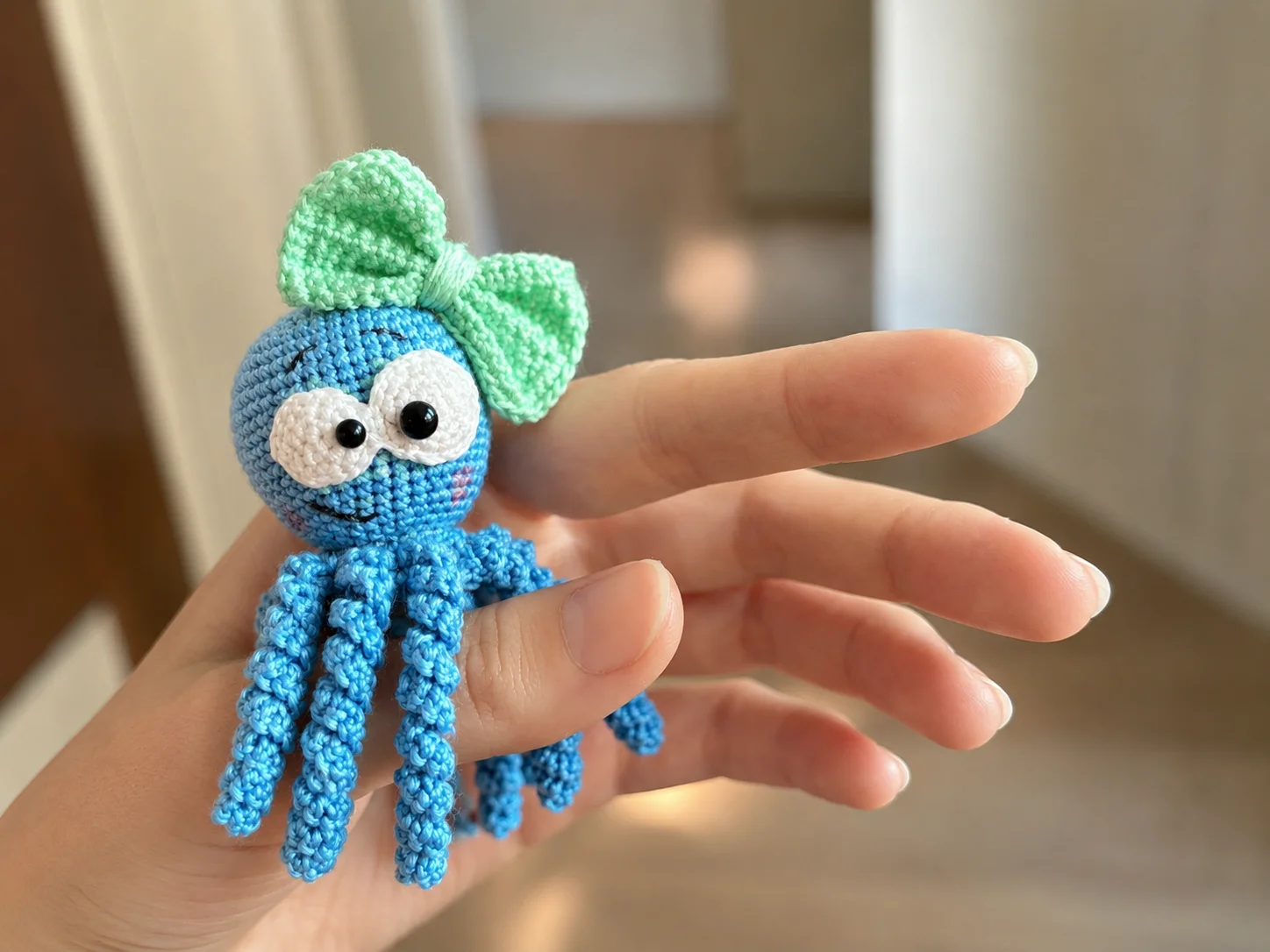
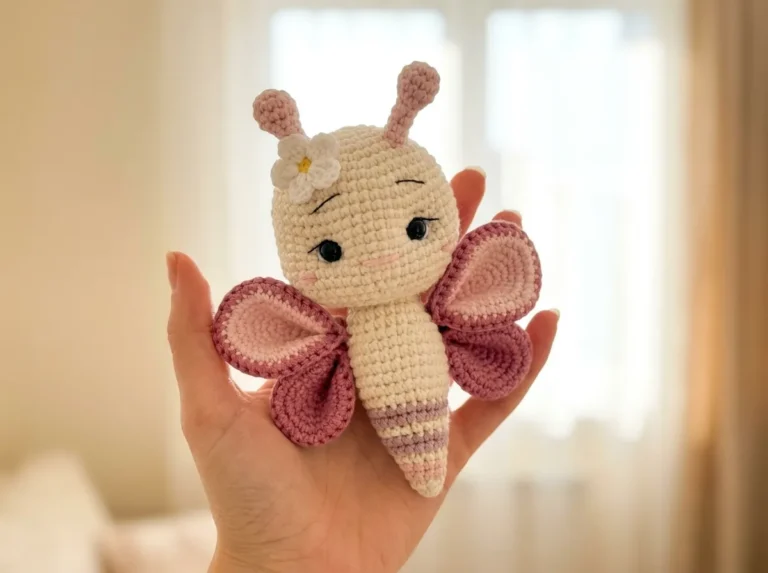
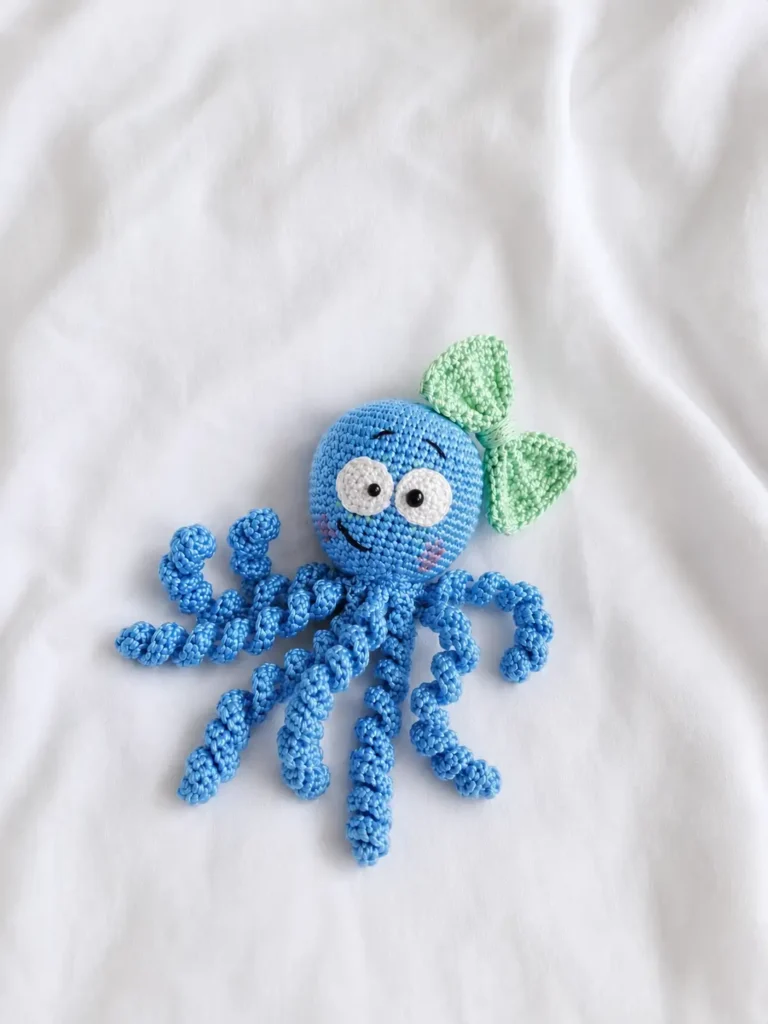
This free octopus amigurumi pattern makes the softest little sea creature you’ve ever tucked into your palm — a round, huggable head-body in the softest blue, eight curled tentacles that spiral out like tiny ribbons, and a sweet embroidered face with mismatched button eyes that somehow make it even more charming. It’s the kind of piece you finish and just… hold for a minute. Let me show you how it all comes together.
🩷 Pattern Highlights
- Cuteness Rating: 🩷🩷🩷🩷🩷
- Finished Size: approx. 2.5–3 in tall (6–7.5 cm), size will vary with your yarn and tension
- Difficulty: Intermediate (the continuous tentacle round takes patience and steady counting)
- Hook Size: 1.25mm steel hook (no US letter equivalent — this size falls below the standard lettered range)
- Yarn Palette: soft powder blue mercerized cotton, with a whisper of contrast for a tiny bow if you’d like one
- Key Detail: two different-sized glass eyes and hand-tinted rosy cheeks for the softest little expression
- Estimated Time: 4-6 hours, mostly spent on the tentacle round
What You’ll Need for This Free Octopus Amigurumi Pattern
This little one is worked in a fine mercerized cotton — think lace or fingering weight — which is exactly what gives it that smooth, defined stitch texture and lets it stay pocket-sized. If you can’t find the exact yarn, any lace-weight or fingering-weight cotton in a similar soft blue will work beautifully.
- Yarn: Mercerized cotton, lace/fingering weight (25g/150m), in a soft powder blue. This is classified as Lace (0) or Fingering (1) depending on your exact skein — check the label if you’re substituting.
- Hook: 1.25mm steel crochet hook (this pattern uses an ultra-fine European steel hook size with no direct US letter equivalent — if you only have US lettered hooks, a US B/1 (2.25mm) with a slightly thinner cotton will get you close, though your finished piece will run a bit larger).
- Eyes: Two round eyes on a stem, 3mm, in two different finished sizes to sit on the two eye pieces (or substitute tiny buttons, or crochet the pupils as the pattern shows below).
- Stuffing: A small handful of polyester fiberfill (Poly-Fil by Fairfield is an easy find at Joann, Michaels, or Hobby Lobby).
- Tapestry needle for sewing and weaving in ends.
- Straight pins or contrast scrap yarn, for marking your rounds — this pattern has a lot of shaping and you’ll want to keep track.
- Oil pastels or dry pastels and a small soft brush, for tinting rosy cheeks.
- Scissors.
🩷 Chloe’s Detail Tip: Because this whole octopus is worked in one continuous piece without cutting the yarn between sections, pick a yarn you genuinely love looking at — you’ll be staring at that one ball of blue for hours, and that’s honestly part of the fun.
Abbreviations for This Crochet Octopus Amigurumi
| Abbreviation | Meaning |
|---|---|
| mr | magic ring |
| ch | chain |
| sc | single crochet |
| sl st | slip stitch |
| inc | increase |
| inv dec | invisible decrease |
| FLO | front loop only |
| BLO | back loop only |
| ( ) | total stitch count for the row |
| ( )*n | repeat the instructions in parentheses n times |
Before You Begin
A few things to know before you pick up your hook — this pattern has some sweet little quirks that make it feel different from a typical amigurumi build.
🩷 Chloe’s Detail Tip: The whole body, all eight tentacles, and the bottom are worked as one continuous piece without ever cutting your yarn. If you’re newer to this technique, our continuous rounds tutorial is a lovely refresher before you dive in — it’ll help you feel confident carrying that one strand all the way through.
This pattern calls for a standard decrease in the original source, but at AmiLoops we always work amigurumi decreases as an invisible decrease instead — it keeps the surface smooth with no visible gap, which matters so much on a piece this small where every stitch shows.
🩷 Chloe’s Detail Tip: Since the two eye pieces in this pattern finish at different sizes on purpose, your octopus ends up with one eye just slightly bigger than the other — a little asymmetry that somehow makes the face even more endearing. Don’t worry about “fixing” it. That’s the whole charm.
Free Octopus Amigurumi Pattern — Head-Body
This is where your little sea friend starts to take shape — a smooth rounding dome that will hold all that soft stuffing and eventually sprout eight tentacles from its base.
Starting Method: Magic ring
Row 1: 6 sc in mr (6)
Row 2: 6 inc (12)
Row 3: (1 sc, inc) 6 (18)
Row 4: (2 sc, inc) 6 (24)
Row 5: (3 sc, inc) 6 (30)
Row 6: (4 sc, inc) 6 (36)
Row 7: (5 sc, inc) 6 (42)
Row 8: (6 sc, inc) 6 (48)
Rows 9-13: sc around, no shaping (5 rows) (48)
This is the roundest part of the whole piece — so satisfying to watch the dome fill out at its widest point.
Row 14: (6 sc, inv dec) 6 (42)
Rows 15-18: sc around, no shaping (4 rows) (42)
Row 19: (5 sc, inv dec) 6 (36)
Rows 20-22: sc around, no shaping (3 rows) (36)
Row 23: (4 sc, inv dec) 6 (30)
Row 24: sc around (30)
Row 25: (4 sc, inv dec) 5 (25)
Row 26: sc around (25)
Row 27: (3 sc, inv dec) 5 (20)
🩷 Chloe’s Detail Tip: Don’t cut your yarn here! You’ll crochet the tentacles directly into the front loops of this last row, so leaving one long continuous strand is exactly what keeps this piece so seamless.
Tentacles — The Best Part of This Octopus Crochet Pattern
This is genuinely the part that takes a little extra love, but it’s also where your octopus goes from “round blob” to “unmistakably an octopus” — those curled little legs are everything.
You’ll make eight tentacles total, working into the front loops (FLO) of row 27.
Tentacle round: For each of the 8 tentacles: chain 42, then starting from the second chain from the hook, work 2-3 sc into each chain stitch so the strip naturally curls in on itself.
Editorial note: the original source pattern doesn’t state a final stitch count for each individual tentacle chain, since the 2-3 sc per chain is worked to taste for curl — Brahim, please confirm before publishing whether we want to specify an exact stitch target here for consistency.
Distribute your eight tentacles evenly around the 20 stitches of row 27 like this:
1st tentacle, 1 sc, 2nd tentacle, 2 sc, 3rd tentacle, 1 sc, 4th tentacle, 2 sc, 5th tentacle, 1 sc, 6th tentacle, 2 sc, 7th tentacle, 1 sc, 8th tentacle, 2 sc. (20)
🩷 Chloe’s Detail Tip: Watching these curl as you crochet each chain is honestly one of my favorite moments in any pattern — that little spiral forms almost on its own, and it’s so hard not to stop and admire each leg before moving to the next.
Add your stuffing now, before closing up the bottom — this is your last chance to reach inside and shape it just right.
Bottom
Still working with the same continuous strand, into the back loops only (BLO) of row 27:
Row 28: (2 sc, inv dec) 5 (15)
Row 29: (1 sc, inv dec) 5 (10)
Row 30: 5 inv dec (5)
Fasten off, pull the small opening closed, and weave in your end. Your stuffing should feel firm but still a little soft — you want it huggable, not stiff.
First Eye
Row 1: 6 sc (6)
Row 2: 6 inc (12)
Row 3: (1 sc, inc) 6 (18)
Row 4: (2 sc, inc) 6 (24)
Row 5: 24 sl st (24)
Leave a long tail of yarn for sewing this in place later.
Second Eye
Row 1: 6 sc (6)
Row 2: 6 inc (12)
Row 3: (1 sc, inc) 6 (18)
Row 4: 18 sl st (18)
Leave a long tail for sewing. This piece finishes smaller than the first eye — that’s exactly the sweet asymmetry we mentioned earlier.
Pupils (make 2)
Row 1: 6 sc in mr (6)
Leave a tail for sewing onto the eye pieces. Felt circles, tiny purchased eyes, buttons, or beads all work beautifully here too, if you’d rather skip crocheting the pupils.
How to Assemble This Crochet Octopus Amigurumi
- Find a spot on the head-body where both eyes look balanced together, even though they’re two different sizes — hold the piece up and look at it straight-on before committing.
- Pin both eye pieces in place first, then step back and check the angle from a few different directions before you start sewing.
- Sew each eye piece securely with your tapestry needle, weaving in ends on the inside where they won’t show.
- Sew a pupil onto each eye piece — centered, or angled slightly inward for an extra sweet, curious expression.
🩷 Chloe’s Detail Tip: With two different eye sizes on this one, level doesn’t mean identical — it means both eyes reading as a matched pair even though they’re not matched in size. I always sit the piece under a lamp and squint at it from a foot away before I sew a single stitch. If something about the placement makes me smile the second I see it, that’s how I know it’s right.
Making It Extra Cute — Finishing Details
This is where it goes from nice to irresistible. The face is really the whole personality of this little octopus, so take your time here.
Embroidered mouth and eyebrows: Using a small amount of contrasting thread and your tapestry needle, stitch a soft curved mouth just below and between the eyes — even a gentle little smile changes the whole expression. Add two small eyebrow stitches above the eyes for that extra spark of personality, if you’d like a slightly more expressive look.
Rosy cheeks: Using your oil pastels or dry pastels and a soft brush, gently buff a little color onto the fabric just below each eye. Start lighter than you think you need — you can always add more, but it’s much harder to take pastel away once it’s blended into the fibers.
Tinting the rest of the piece: If you’d like, you can lightly tint the tentacles or the top of the head with a whisper of a deeper shade for subtle dimension — just a soft brush pass, nothing heavy-handed.
A tiny bow: A small contrast-color bow tied or sewn just above the eyes adds one more sweet detail without competing with the face.
Chloe’s Final Look
I keep picking this little octopus up just to look at it — the way those tentacles curl in every direction, the soft blue against the pink of the cheeks, those two not-quite-matching eyes giving it the most curious little expression. It fits right in your palm and somehow looks like it has a whole personality already. Try it in a dusty lavender or a soft mint for a whole tiny reef of them lined up together. 🩷
FAQ
What yarn is best for this octopus amigurumi?
A fine mercerized cotton in lace (0) or fingering (1) weight works best. It gives the octopus a smooth, defined stitch texture and ensures it stays pocket-sized.
How long does it take to crochet this octopus pattern?
It typically takes about 4 to 6 hours to complete. Most of that time is spent patiently working on the continuous tentacle round to get the perfect curl.
Do I have to cut the yarn between the body and tentacles?
No, the entire head-body, all eight tentacles, and the bottom closure are worked as one continuous piece to keep the finish completely seamless.