Free Stitch Amigurumi Pattern — Easy Beginner Crochet
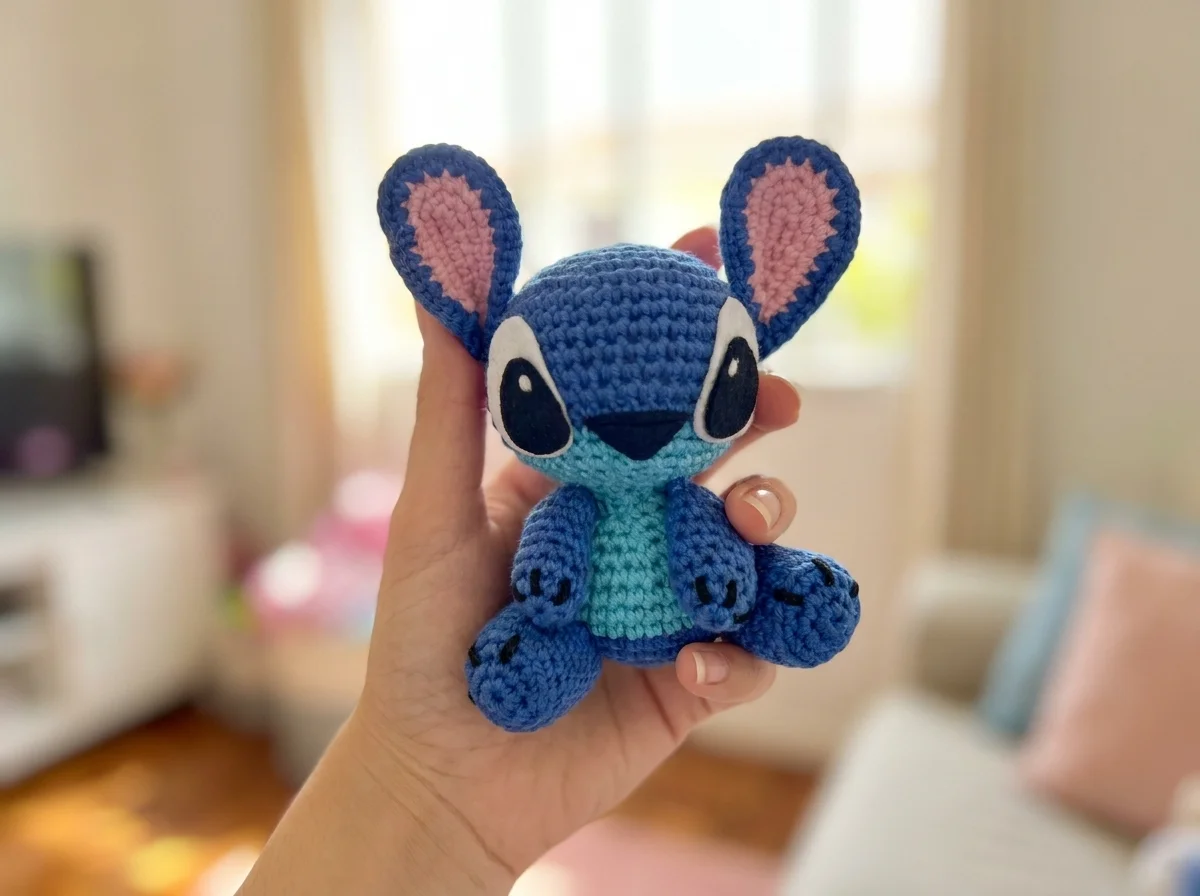
This free Stitch amigurumi pattern is basically pure crochet joy — a round little blue alien with giant ears, a light blue chest, and a face so expressive you’ll want to make ten of them. He’s worked almost entirely in simple single crochet rounds, the color change on the body is easier than it looks, and the whole thing comes together in one cozy evening. Grab your hook. Let’s build Stitch.
🧶 Why You’ll Love This Pattern
- ⭐ Difficulty: EASY — beginner-friendly from round one
- ⏱️ Time: 3–4 hours — very doable in one sitting
- 🪡 Sewing: Standard — head, arms, legs, ears, and tail attach at the end
- 🧵 Yarn: DK or light worsted cotton — structured, clean stitch definition
- 💰 Yarn needed: Small amounts of blue, light blue, pink, and black
What You’ll Need for This Stitch Amigurumi
The materials list here is genuinely short. Nothing fancy, nothing hard to find.
- Blue cotton yarn — main color, DK or Light Worsted (weight 3). Lion Brand 24/7 Cotton or Paintbox Simply Cotton DK are great US options. Check Joann, Michaels, or Hobby Lobby.
- Light blue cotton yarn — small amount for the chest and head fade
- Pink cotton yarn — small amount for the inner ears
- Black cotton yarn — tiny amount for embroidering the nose and claws
- 2.5mm crochet hook (closest US size: approx. C/2 — but 2.5mm is the specific size used here)
- Polyester fiberfill — Poly-Fil by Fairfield works great, available at any US craft store
- Tapestry needle — blunt-tipped, for sewing parts and weaving in ends
- Scissors
- Black and white felt — for the eyes
- Hot glue gun — or needle and thread to attach felt eyes
- Stitch marker — non-negotiable for tracking your rounds
Can’t find DK cotton? Any cotton-blend DK or light worsted that crochets up tightly works fine. The key is getting a dense fabric so the stuffing doesn’t peek through.
Abbreviations
| Abbreviation | Meaning | Plain English |
|---|---|---|
| ch | chain | Yarn over, pull through loop |
| sc | single crochet | Insert hook, yarn over, pull through, yarn over, pull through both loops |
| inc | increase | Work 2 single crochets into the same stitch — adds width |
| dec | decrease (invisible method) | Insert hook through front loops only of the next 2 stitches at once, yarn over, pull through, yarn over, pull through 2 loops. AmiLoops always uses the invisible decrease — it keeps things tidy |
| mr | magic ring | An adjustable loop start — closes the center hole completely |
| BLO | back loop only | Insert your hook through only the back loop of the stitch |
| st(s) | stitch(es) | — |
| FO | fasten off | Cut yarn, pull through last loop to secure |
A Few Tips Before You Start Your Stitch Amigurumi
The magic ring is your best friend here. Almost every part of this pattern starts with one, and it gives you a perfectly closed center — no hole, no gap. If it sounds intimidating, it really isn’t. Our magic ring tutorial walks you through it step by step and you’ll have it down in under two minutes.
Use a stitch marker every single round. This pattern works in continuous rounds — no joining, no slip stitch at the end of each row. That’s actually the easier method, but it means you need to mark where each round begins or you’ll lose count fast. Move your stitch marker up as you go.
The color change is easier than it looks. Rows 8–14 of the body and row 15 of the head involve switching between blue and light blue. It sounds complicated, but it’s really just carrying one color and picking up the other at the right spot. Our guide on how to change colors in amigurumi breaks it down clearly if you want a visual walkthrough first.
Don’t stuff the arms. This is called out in the pattern and it matters — flat arms drape naturally and look much more intentional than stuffed ones on a piece this size.
New to amigurumi entirely? Start with our complete beginner’s guide to amigurumi before diving in — it covers all the foundational stuff that’ll make this pattern click.
Free Stitch Amigurumi Crochet Pattern
Body (make 1)
Start with blue yarn. The light blue section begins partway through and creates the chest panel.
Row 1: 6 sc in mr (6)
Row 2: (inc) × 6 (12)
Row 3: (inc, sc) × 6 (18)
Row 4: (inc, 2 sc) × 6 (24)
Row 5: (inc, 3 sc) × 6 (30)
Row 6: (inc, 4 sc) × 6 (36)
Row 7: 36 sc (36)
🎉 The base is done! That round little dome is exactly what you want. From here the color work starts — don’t panic, it’s just two colors and you switch them at the same point each row.
Rows 8–10: Work 11 sc in light blue, then 25 sc in blue. Repeat for 3 rows. (36 each row)
Switch colors at the same stitch each row to keep the chest panel clean and vertical. Carry the unused yarn loosely on the inside.
Row 11: (dec, 4 sc) × 2 in light blue, (dec, 4 sc) × 4 in blue (30)
Row 12: (dec, 3 sc) × 2 in light blue, (dec, 3 sc) × 4 in blue (24)
Row 13: (dec, 2 sc) × 2 in light blue, (dec, 2 sc) × 4 in blue (18)
Row 14: (dec, sc) × 2 in light blue, (dec, sc) × 4 in blue (12)
Stuff the body firmly before the opening gets too small. Leave the last few stitches open for now — you’ll close and attach the head later. FO and leave a long tail for sewing.
Head (make 1)
Start with blue yarn. Light blue takes over in row 15 for the lower face area.
Row 1: 6 sc in mr (6)
Row 2: (inc) × 6 (12)
Row 3: (inc, sc) × 6 (18)
Row 4: (inc, 2 sc) × 6 (24)
Row 5: (inc, 3 sc) × 6 (30)
Row 6: (inc, 4 sc) × 6 (36)
Row 7: (inc, 5 sc) × 6 (42)
Rows 8–14: 42 sc (7 rows) (42)
Row 15: 42 sc in light blue (42)
Row 16: (dec, 4 sc) × 7 (35)
Row 17: (dec, 3 sc) × 7 (28)
Row 18: (dec, 2 sc) × 7 (21)
Row 19: (dec, sc) × 7 (14)
Stuff the head well — it should feel firm and hold its round shape. Close the remaining stitches with your tapestry needle, weave in the end. Set aside.
🎉 Two biggest parts: done. Honestly? That’s the bulk of the work right there. Everything else is smaller and quicker. You’re doing great.
Arms (make 2)
Blue yarn. Do not stuff these — flat arms look much better at this scale.
Row 1: 6 sc in mr (6)
Row 2: (inc) × 6 (12)
Rows 3–8: 12 sc (6 rows) (12)
Row 9: (dec) × 6 (6)
FO, leave a tail for sewing. No stuffing — just flatten them slightly before attaching.
Legs (make 2)
Blue yarn. The BLO row creates a little ridge at the base — totally intentional, it’s where the foot meets the leg.
Row 1: 6 sc in mr (6)
Row 2: (inc) × 6 (12)
Row 3: (inc, sc) × 6 (18)
Row 4: BLO — 18 sc (18)
Rows 5–12: 18 sc (8 rows) (18)
Row 13: (dec, sc) × 6 (12)
Stuff the legs firmly, especially the foot section. FO, leave a tail for sewing.
Ears (make 4: 2 blue + 2 pink)
These are flat pieces worked back and forth from a foundation chain — not in the round. Make 2 in blue and 2 in pink. They get paired together at the end.
Row 1: Ch 8, turn. Starting from the 7th chain, work 6 sc. Work 3 sc in the first chain (corner). Turn and work 6 sc back along the other side. Work 3 sc in the last chain (other corner). (18)
Row 2: inc, 5 sc, inc, sc, inc, 6 sc, inc, sc, inc (23)
Row 3 (corrected): sc, inc, 4 sc, inc, sc, inc, 4 sc, inc, sc, inc, sc, inc, 5 sc (29)
⚠️ Heads up — ear Row 3 fix. The original source pattern lists Row 3 as: sc, inc, 6 sc, inc, sc, inc, 7 sc, inc, sc, inc, sc, inc, 8 sc — but that sequence tries to work 31 stitches into only 23 available stitches, which doesn’t add up. The corrected version above reduces the plain sc groups proportionally (6→4, 7→4, 8→5) so the row correctly consumes all 23 stitches and produces 29. Use the corrected version.
FO each ear piece. Once you have all four, pair one blue ear with one pink ear, place them together with wrong sides facing, and join by working 2 sc through each matching stitch around the edge. You’ll end up with two finished layered ears — blue on the outside, pink on the inside.
Tail (make 1)
Blue yarn (inferred from finished photo). Quick little tube — this works up in about two minutes.
Row 1: 6 sc in mr (6)
Rows 2–4: 6 sc (3 rows) (6)
FO, leave a tail for sewing. No need to stuff this one.
Assembly
Okay, I won’t lie — this is the most involved part. There’s real sewing here. But go in order, pin everything before you commit, and it’ll come together nicely.
- Head to body first. Position the head centered on top of the body and sew it in place using your tapestry needle and the tail you left. Make sure you’re happy with the angle before you secure it — you can’t easily undo this step.
- Ears next. The ears go on the sides of the head, positioned wide and slightly forward. Look at your reference photo and pin them before sewing. Secure firmly — they’re big and will flop if they’re not well-anchored.
- Arms on the upper body. Sew one arm to each upper side of the body, just below where the head attaches. Flat and unstuffed — they should hang naturally.
- Legs at the lower body. Position the legs at the lower sides of the body so the piece sits stably. Stuff any remaining gaps if needed before closing.
- Tail at the back. Sew the tail to the center back of the body, low down. It’s small — just a few securing stitches is enough.
Take your time with this step. Pinning before sewing is genuinely worth it. Uneven parts are the one thing that’s hard to fix once the yarn is through.
Decoration
This is where Stitch gets his face — and honestly it’s one of the most satisfying parts of the whole project.
- Eyes: Cut two oval shapes from black felt and two smaller ovals from white felt. Layer white on black, then attach with a hot glue gun or sew them in place with a needle and thread. Position them on the light blue section of the face, wide-set and slightly angled for maximum character.
- Nose: Embroider a small black triangle in the center of the light blue face area using black yarn and your tapestry needle. Three or four straight stitches forming a triangle shape.
- Claws: Embroider three short straight stitches at the end of each arm and each leg using black yarn. Three per piece — simple and effective.
🎉 Look at that face. Once those eyes go on, the whole thing just clicks into place. That’s your Stitch, right there. You made that.
You Did It!
Seriously — look at the little guy. Between the color-change body, those giant layered ears, and the embroidered details, this is not a beginner project that looks like a beginner project. It looks like something you’d pay real money for. And you made it yourself, in one evening. That’s worth being ridiculously proud of.
If this was your first amigurumi, I hope you’re already thinking about the next one. If it wasn’t — I hope it was as cozy and satisfying for you as it was for me. Share a photo if you make one. I want to see every single squishy version. 🧶
What yarn is best for this free Stitch amigurumi pattern?
DK or light worsted cotton is the best choice — it creates a dense, structured fabric that holds its shape well and prevents the stuffing from showing through. Lion Brand 24/7 Cotton and Paintbox Simply Cotton DK are two widely available options in the US.
How long does it take to make this Stitch amigurumi?
Most crocheters finish this pattern in 3–4 hours, making it a very achievable one-evening project. The color-change body and the head are the most time-intensive parts; the arms, tail, and ears work up quickly.
Can beginners make this Stitch amigurumi pattern?
Yes — the pattern is rated EASY and uses only single crochet throughout. The two-color chest panel looks impressive but is straightforward to execute. Beginners should read the tips section first, particularly the notes on using a magic ring and tracking continuous rounds with a stitch marker.