The Ultimate Beginner’s Guide to Amigurumi: Start Here
Amigurumi is the Japanese art of crocheting small, stuffed yarn figures — and it requires mastering exactly one stitch to begin. This guide covers every supply, technique, and assembly step a complete beginner needs. By the end, you will know how to make your first amigurumi from the magic ring to the final sewn seam.
I built AmiLoops because every beginner guide I found either skipped the hard parts or buried them in paywalled PDFs. I have frogged more first-round magic rings than I can count — so I know exactly where this gets confusing. Here is everything I wish someone had laid out clearly before I picked up my first hook.
What Is Amigurumi — And Why Every Beginner Can Make One
Amigurumi are small crocheted stuffed figures worked almost entirely in single crochet. If you can learn one stitch and count to twelve, you can finish your first amigurumi project.
The word comes from Japanese: ami (crocheted or knitted) and nuigurumi (stuffed doll). The style originated in Japan and has become one of the most popular forms of crochet worldwide — and for good reason. The shapes are forgiving, the projects are small, and the skill ceiling for a first piece is genuinely low.
The One Stitch That Makes Amigurumi Possible
The single crochet (sc) is the foundation of nearly every amigurumi pattern ever written. It is a short, dense stitch that pulls fabric tight — which is exactly what you want when you are stuffing a piece with polyfill. A tighter fabric means the stuffing stays hidden and the shape holds cleanly.
You will also use two variations of the single crochet: the increase (inc), which is simply two single crochets worked into the same stitch, and the invisible decrease (inv dec), which closes two stitches into one without leaving a visible gap. Those three moves — sc, inc, inv dec — are the complete technical toolkit for most beginner amigurumi patterns.
Why Amigurumi Is the Best First Crochet Project
Larger crochet projects — blankets, garments, scarves — require you to maintain consistent gauge across hundreds of rows. A small amigurumi project is worked in rounds, not rows, and each round is usually between six and thirty stitches. You get constant feedback. If your stitch count is wrong, you find out within two minutes, not two hours.
Emma’s experience shows that beginners who start with amigurumi develop tighter, more controlled tension faster than those who start with flat projects — because every stitch is visible and the small scale makes mistakes impossible to ignore. That is not a flaw. That is how you learn.
What You Will Make by the End of This Guide
This guide does not produce a specific pattern, but it gives you every building block needed to follow one. After reading, you will be able to start a magic ring, work single crochet in continuous rounds, shape a sphere using increases and decreases, attach safety eyes, stuff with polyfill, and sew finished pieces together with a tapestry needle. That is a complete amigurumi workflow.
Everything You Need Before You Start (and Nothing You Don’t)
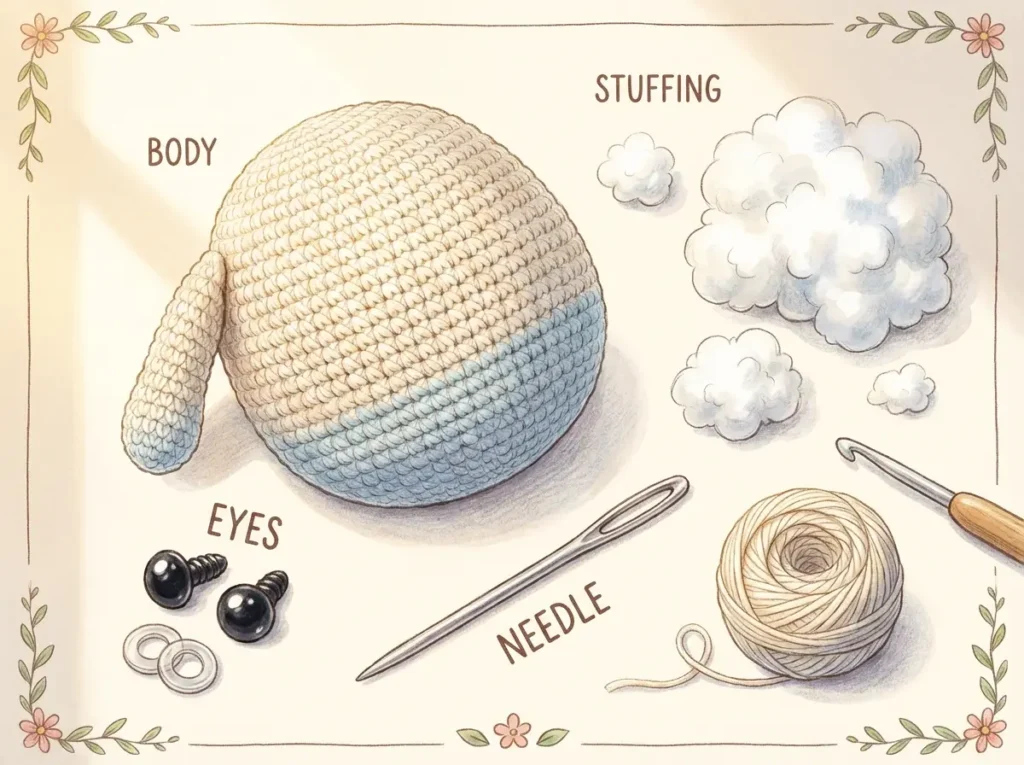
You need six things to start amigurumi: yarn, a hook, stitch markers, safety eyes, polyfill, and a tapestry needle. Every one of these is available at Joann, Michaels, or Hobby Lobby for under forty dollars total.
Beginner supply lists online tend to balloon into twenty-item wishlists. Ignore them. The list below is the actual minimum. You can add tools later once you know what bothers you about your process — but none of these six things are optional.
Choosing the Best Yarn for Amigurumi Beginners
Yarn choice has a bigger effect on your finished amigurumi than almost any other variable. The wrong yarn makes stitches muddy, stuffing visible, and shapes soft where they should be crisp.
For beginners, a smooth worsted weight (CYCA 4) acrylic in a light or medium color is the most forgiving starting point. It is widely available, easy to see individual stitches in, and gives you the most control over tension while you are still building muscle memory. My personal preference is fingering weight (CYCA 1) mercerized cotton on a 2.5mm hook — but that combination punishes inconsistent tension, and I would not recommend it as your first yarn.
Avoid fuzzy, fluffy, or textured yarns entirely. You cannot see your stitches, you cannot count accurately, and frogging becomes a nightmare. Read more about fiber types and specific brand recommendations in the guide to best yarn for amigurumi beginners.
The Right Hook Size for Tight, Clean Stitches
Amigurumi requires a tighter fabric than the yarn label recommends. If you use the suggested hook size on the skein band, your stitches will be too open, and stuffing will show through the gaps.
A general rule: go one to two hook sizes smaller than the yarn label suggests. For a worsted weight acrylic that recommends a 5.0mm hook, try a 3.5mm (US E/4) or 4.0mm (US G/6). After testing dozens of yarn and hook combinations, I have found that the tighter your baseline tension, the less hook size reduction you need — but if you are a beginner, start small.
Always test a few rounds and check whether the stuffing is visible. If it is, go smaller. For full guidance on hook sizing by yarn weight, see choosing the right hook size.
The Five Tools You Actually Need
- Crochet hook — sized for your chosen yarn, as discussed above
- Stitch marker — one locking clip marker to mark the first stitch of every round. Non-negotiable.
- Safety eyes — plastic eyes with locking washers. Common beginner sizes are 9mm and 12mm. Available at Michaels and Joann in the yarn aisle.
- Polyfill stuffing — Poly-Fil by Fairfield is the US standard. One bag will last dozens of small projects.
- Tapestry needle — a blunt yarn needle for sewing pieces together and weaving in ends. Also called a darning needle or yarn needle.
Scissors are assumed. Everything else — yarn bowls, blocking mats, needle gauges — comes later.
The Foundation Techniques Every Amigurumi Begins With
Every amigurumi starts with a magic ring, followed by single crochet stitches worked in a continuous spiral. Master these two techniques and you have the complete foundation for every round-based pattern.
How to Make a Magic Ring
The magic ring (MR) — also called the magic circle or adjustable ring — is an adjustable loop start that closes completely to eliminate the hole at the center of your work. Every amigurumi piece that is worked in the round starts here. A starting chain would leave an open hole that is impossible to close cleanly.
Here is how to form one:
- Drape the yarn over your non-dominant hand, leaving a 6-inch tail. The working yarn (attached to the skein) goes over your index finger.
- Wrap the working yarn once around your index and middle fingers to form a loop.
- Insert your hook through the center of the loop, catch the working yarn, and pull up a loop.
- Chain 1 to secure the ring (this does not count as a stitch).
- Work the required number of single crochets into the center of the ring.
- Pull the tail end firmly to close the center hole before continuing.
The ring should close completely with no hole visible. If it does not, your starting wrap was too loose. Practice this five times before moving on — it is the most common stumbling point for beginners, and it is entirely a muscle memory issue.
For a full step-by-step walkthrough with additional tips on closing the ring, visit how to make a magic ring.
The Single Crochet Stitch, Step by Step
The single crochet (sc) is the stitch you will use for ninety percent of your amigurumi work. Here is the exact sequence:
- Insert your hook into the next stitch from front to back.
- Yarn over (wrap yarn over hook from back to front).
- Pull the yarn back through the stitch. You now have two loops on your hook.
- Yarn over again.
- Pull through both loops on the hook. One loop remains. One single crochet is complete.
That is the complete motion. Keep your tension even and your hook angle consistent. Emma’s experience shows that beginners who consciously slow down on step three — making sure they pull through only the stitch and not accidentally split the yarn — eliminate the majority of their tension problems within the first hour of practice.
Working in Continuous Rounds With a Stitch Marker
Amigurumi is worked in continuous rounds — a spiral with no slip stitch join and no turning chain between rounds. This is the standard method because it eliminates the visible seam line that joined rounds create.
The challenge: without a join, you cannot see where one round ends and the next begins. This is where the stitch marker becomes essential. Place one locking marker in the first stitch of every round. When you come back around and reach the marker, that stitch completes the current round. Move the marker into the first stitch of the new round and continue.
Never skip the stitch marker. Missing it by even one stitch compounds into a misshapen piece within three or four rounds — and the only fix is frogging.
Shaping Your Amigurumi — Increases and Decreases
Increases add stitches to widen your piece and decreases remove stitches to close it. Every 3D shape in amigurumi — every sphere, cone, and cylinder — is built entirely from these two techniques.
How to Work an Increase (inc)
An increase is two single crochets worked into the same stitch. That is the complete definition. When a pattern says “inc,” insert your hook into the indicated stitch and work a single crochet as normal — then, without moving to the next stitch, insert your hook into the same stitch again and work a second single crochet. You have added one stitch to your total count.
Increases are evenly spaced around a round to expand the circumference gradually. A round that reads “sc 1, inc” repeated six times will take you from 6 stitches to 12. The next increase round takes you from 12 to 18, and so on. This arithmetic is how a flat disc grows into a hemisphere.
How to Work an Invisible Decrease (inv dec)
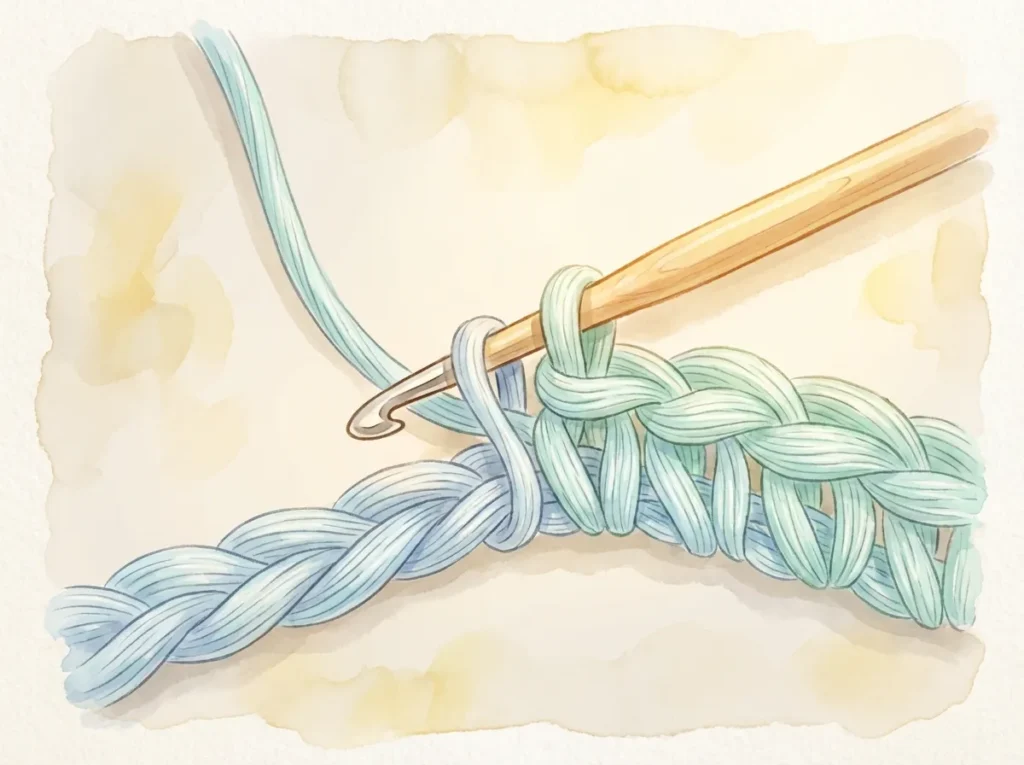
The invisible decrease (inv dec) removes one stitch from your count by merging two stitches into one — but it does so through the front loops only, which keeps the join tight and invisible on the right side of the work.
Here is the exact method:
- Insert your hook through the front loop only of the next stitch.
- Without removing the hook, insert it through the front loop only of the following stitch.
- You now have three loops on the hook (the two front loops and your working loop).
- Yarn over and pull through all three loops in one motion.
One stitch removed. No gap. For a complete step-by-step guide with close-up technique photos, read the full tutorial on the invisible decrease.
Why the Invisible Decrease Beats the Standard Decrease Every Time
The standard decrease — sc2tog — inserts through both loops of each stitch. This leaves a visible horizontal gap on the right side of the piece. On a small amigurumi worked in a light or medium color yarn, that gap is obvious.
The invisible decrease works through the front loops only, which pulls the stitch closed from the outside surface inward. The result is a smooth, uninterrupted fabric on the right side. There is no situation in amigurumi where sc2tog is preferable to inv dec. Use the invisible decrease. Every time.
Emma’s Pro Tip: The invisible decrease feels awkward at first because you are inserting through two front loops simultaneously — the hook angle is more horizontal than usual. On my 2.5mm hook with mercerized cotton, I hold the fabric slightly taut with my left hand while inserting. That single adjustment eliminates ninety percent of missed-loop errors immediately.
Assembly — Stuffing, Eyes, and Sewing Parts Together
Safety eyes must be positioned and locked in place before you close and stuff your piece — once the opening is too small for your hand, it is too late. Add polyfill gradually as you close, and use a tapestry needle to sew all finished parts into a single finished figure.
When and How to Attach Safety Eyes
Safety eyes are plastic eyes with a post on the back. A washer locks onto the post from the inside of your piece, and once locked, the washer cannot be removed without cutting the fabric. This is why placement must happen before closing.
Position the eyes when your piece is about seventy percent closed — enough of an opening to reach your hand inside to press the washer on, but with enough fabric formed to see exactly where the eyes will sit. Hold them in place without locking, step back, and assess the expression. Move them if needed. Once that washer clicks, the decision is permanent.
Common beginner sizes: 9mm for small pieces (under 4 in tall), 12mm for medium pieces (4–6 in tall). Both are widely available at Michaels and Joann.
How to Stuff Amigurumi for the Right Shape
Pull small amounts of polyfill apart before inserting — a single clump stuffed in whole creates hard spots and uneven lumps on the surface. Separate the filling into pieces about the size of a golf ball, tease them loosely apart, and push them in gradually, using the eraser end of a pencil to press into corners and curves.
Stuff firmly. More firmly than feels right. Polyfill compresses over time, and an understuffed amigurumi develops a deflated, wrinkled surface within weeks. When you press the piece and it bounces back immediately with no visible indentation, the stuffing level is correct.
Sewing Parts Together Cleanly
Thread your tapestry needle with a long tail of matching yarn — at least 18 in. Pin or hold the piece in position before making a single stitch. The placement of ears, limbs, and tails changes the entire character of an amigurumi, and adjusting after you have sewn six stitches is far more work than spending thirty seconds repositioning first.
Use a whip stitch or mattress stitch to attach pieces. Work through the outer loops of both the piece and the main body, alternating sides, pulling firmly but not so tight that the fabric puckers. Weave the tail end invisibly through at least four stitches before trimming.
How to Read an Amigurumi Pattern (Without Getting Lost)
Amigurumi patterns are written in abbreviations — sc, inc, inv dec, MR — and organized by round number. A stitch count in parentheses at the end of each round tells you exactly how many stitches you should have, and checking it every round prevents every major mistake before it compounds.
Common Abbreviations and What They Mean
Most beginner patterns use a small, consistent set of abbreviations. Here are the ones you will see in almost every pattern:
- MR — Magic ring
- sc — Single crochet
- inc — Increase (2 sc in the same stitch)
- inv dec — Invisible decrease
- sl st — Slip stitch (used to join, rarely in amigurumi rounds)
- ch — Chain
- FLO — Front loop only
- BLO — Back loop only
- R or Rnd — Round
A pattern instruction like “sc 2, inc” means: work 2 single crochets normally, then work 1 increase. The number after an abbreviation tells you how many times to work it before moving to the next instruction.
How to Follow a Round-by-Round Pattern
Amigurumi patterns list instructions round by round, starting from round 1. Each round begins with a number — Rnd 1, Rnd 2, and so on — followed by the stitch instructions, followed by a stitch count in parentheses.
Example: Rnd 4: sc 1, inc, sc 2, inc, sc 1 (10)
Work each instruction left to right across the round. When you have completed every instruction in that line, you should have exactly the number of stitches shown in the parentheses. If you do not, something went wrong in that round — not three rounds ago. Find and fix it now.
The Stitch Count Check That Prevents Every Major Mistake
Count your stitches at the end of every single round. This is not optional. This is how you crochet amigurumi.
Place your stitch marker at the first stitch of each new round, then count around the entire round by tapping each stitch with your hook tip as you count. If the number matches the pattern’s parenthetical count, continue. If it does not, stop and find the discrepancy before adding another stitch.
After testing dozens of beginner patterns side by side, I can confirm that one hundred percent of “my finished piece looks wrong” problems trace back to a stitch count error that was not caught early. Count every round. No exceptions.
Common Amigurumi Mistakes — And How to Fix Them
The three most common beginner mistakes are losing stitch count, working without a stitch marker, and using a standard decrease instead of the invisible decrease. All three are fixable — sometimes by frogging, but more often by catching them early with a consistent counting habit.
Losing Your Stitch Count and How to Recover
If you finish a round and your count is off by one or two stitches, the fix depends on where you are in the pattern. If you are on round 4 of a 20-round piece, frog back to the round where your count was last correct and redo from there. Do not try to compensate by adding or removing stitches in the current round — you are not fixing the problem, you are redistributing it.
If you are far into a piece and the error is cosmetic rather than structural, assess honestly. A single stitch off in a wide middle round of a sphere often does not affect the final shape. A stitch off during an increase or decrease round almost always does.
Holes, Gaps, and Visible Decreases — The Causes and Fixes
A hole at the center of your piece means the magic ring was not pulled closed tightly enough, or was not knotted before continuing. Frog back to round 1 and close the ring fully before working any stitches into it.
Visible gaps along decrease lines mean you are using sc2tog instead of the invisible decrease. Switch to inv dec for every decrease from this point forward. If the gaps are already made, they cannot be fixed without frogging those rounds.
Loose, uneven fabric that lets stuffing show through is almost always a hook size problem. Try the next size down.
When to Frog and When to Keep Going
Frogging — unraveling your work — is not failure. It is precision. I have frogged a nearly completed piece because one round of increases was placed one round too early, creating a slightly squared base instead of a clean sphere. No one else would have noticed. I noticed.
A useful rule: if the mistake affects the structural shape of the piece, frog back to before it happened. If the mistake is visible only to you under direct light while holding the piece three inches from your face, finish the piece, learn from it, and start a cleaner one next time. Gauge is a skill. It builds with repetition, not with regret.
You have everything you need to start your first amigurumi project. From the magic ring to the final seam, the techniques in this guide cover the complete beginner workflow — and every one of them improves with practice. Your first piece will not be perfect. It will be a foundation. Ready to take your next step? Learn how to make a magic ring and build on what you just mastered.
What is amigurumi for beginners?
Amigurumi is the craft of crocheting small, stuffed yarn figures using primarily the single crochet stitch. It is one of the most beginner-friendly crochet projects available because it requires minimal supplies, uses only a few core stitches, produces small finished pieces quickly, and gives constant feedback through round-by-round stitch counts.
What crochet stitch do you use for amigurumi?
The single crochet (sc) is the foundation stitch of amigurumi and makes up the majority of every pattern. Two variations — the increase (2 sc in one stitch) and the invisible decrease (inv dec, worked through front loops only) — handle all shaping. Most beginner patterns use nothing else.
What yarn is best for a beginner amigurumi?
A smooth worsted weight (CYCA 4) acrylic in a light or medium color is the best starting yarn for beginners. It is forgiving, easy to count stitches in, and widely available at US craft stores. Avoid fluffy or textured yarns — they hide stitches and make accurate counting nearly impossible.
Do I need to know how to crochet before starting amigurumi?
No prior crochet experience is required. Amigurumi is an excellent entry point into crochet because the projects are small, the stitch vocabulary is narrow, and mistakes are caught quickly. Learning the single crochet, magic ring, increase, and invisible decrease gives you everything needed to follow a complete beginner amigurumi pattern.