A Crochet Pillow That Looks Expensive — Made Almost Entirely From Scraps
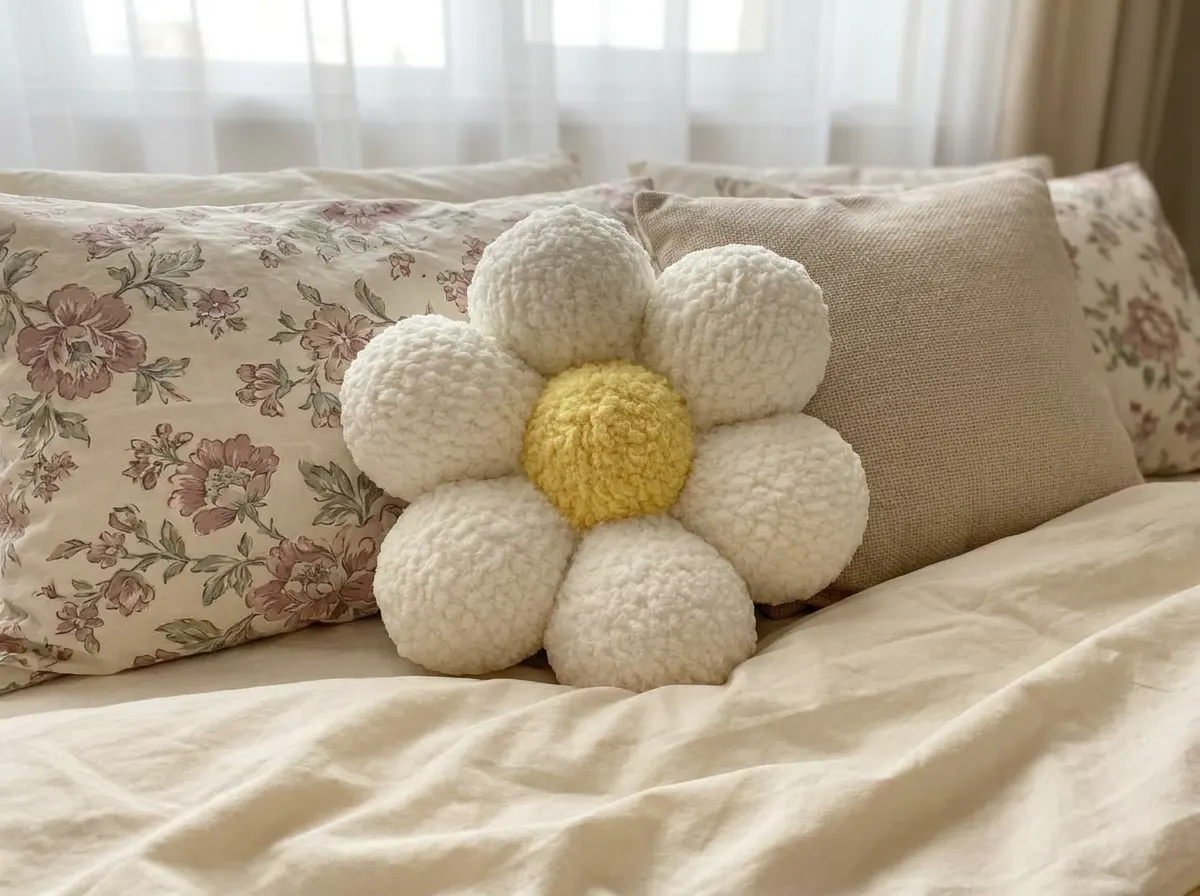
If you are looking for a quick crochet pillow project, this free daisy pattern is the kind of project your stash has been waiting for — two colors of bulky chenille yarn, a 5.0mm hook, and about an afternoon of your time. The whole thing is built from a single repeated shape: a stuffed petal you’ll make six times, plus one squishy center. That’s it. If you’ve got leftover chenille from another project — even two partial skeins in different shades — you might already have everything you need. Grab your hook and let’s go.
🧶 What You’ll Need From Your Stash
- 💰 Yarn Needed: ~250 yards total (approx. 200 yds petal color + 50 yds center color — estimates for Bulky weight chenille)
- 🎨 Colors: lemon yellow (petals) + cream (center) — or swap them; any two contrasting Bulky chenille colors work
- 🪝 Hook: H/8 (5.0mm)
- ⏱️ Time: 4–6 hours (6 petals + assembly)
- 📏 Finished Size: Not specified by designer — final size depends on yarn brand and your tension; expect approximately 12–15 in across with Bulky (5) chenille
- 💡 Difficulty: Intermediate
- 🎁 Great For: home decor, nursery accents, handmade gifts, market items, seasonal displays
Materials for Your Crochet Daisy Pillow
The beauty of this crochet pillow is how little it actually demands from your stash. Two colors. One hook. Some stuffing. That’s the whole shopping list.
- Lemon yellow chenille yarn — Bulky (5) weight, approximately 200 yards. The original uses Softy Mega by Alize in color 187 Lemon Yellow. US alternatives in the same weight category: Bernat Baby Velvet or Premier Parfait. Any soft Bulky (5) chenille in your stash works — the squishy texture is what makes this pillow so satisfying to hold.
- Cream chenille yarn — Bulky (5) weight, approximately 50 yards. Original: Softy Mega by Alize in color 62 Cream. Same US alternatives apply. Got a leftover ball of cream from a baby project? That’s probably more than enough for the center.
- Hook: H/8 (5.0mm)
- Blunt-tip yarn needle — for sewing the petals onto the center
- Polyester fiberfill stuffing — you’ll need a generous amount; each petal gets stuffed individually. Poly-Fil by Fairfield is widely available at Joann, Michaels, and Hobby Lobby.
- Scissors
- Stitch markers — at least 2; essential for marking Rows 7 and 9 on the center piece during assembly
A quick note on chenille: this yarn category is lush and fast-working, but it does hide your stitches. Good lighting and a slower pace on the increase and decrease rows will save you from having to frog and redo. This yarn falls under Bulky (5) weight on the standard yarn weight system — the thick, squishy category that works up fast and makes even simple shapes look intentional.
Abbreviations Used in This Crochet Pillow Pattern
| Abbreviation | Meaning |
|---|---|
| sc | single crochet |
| inc | increase (2 sc in same stitch) |
| dec | decrease — use the invisible decrease method (see tip below) |
| ch | chain |
| sl st | slip stitch |
| mr | magic ring |
| FO | fasten off |
Smart Crafter Tips
Use the invisible decrease on every “dec” in this pattern. The pattern calls for dec throughout — always use the invisible decrease method here. Insert your hook through the front loops only of the next two stitches simultaneously, yarn over, pull through, yarn over, pull through both loops. In chenille especially, this keeps the surface smooth and gap-free. The standard sc2tog creates a visible hole that shows right through the plush fabric. Not worth it. If the invisible decrease is new to you, our invisible decrease tutorial walks through it stitch by stitch.
Mark Rows 7 and 9 on your center piece before you close it. This is non-negotiable. The assembly method sews each petal onto two specific rows of the center — if you lose track of which round is which, assembly becomes a guessing game. Drop a stitch marker into Row 7 and another into Row 9 the moment you finish those rounds. Leave them in until every single petal is attached.
Make all 6 petals before you start sewing. It’s tempting to attach petals as you go, but having all six finished first lets you line them up and check for consistent size before committing. Chenille yarn can behave differently across a project depending on your tension — having all the pieces on the table gives you a chance to pair similar-sized petals and distribute any slight variations evenly around the center. New to working in continuous rounds? Our guide to continuous rounds covers the spiral method that keeps your work clean and seamless.
🧶 Scrap Check: Each petal uses roughly 30–35 yards of Bulky chenille. If you’ve got a partial skein of any yellow or warm-toned chenille sitting in your stash, count your yardage before buying anything new. Two partial skeins at 100 yards each will cover this entire project with yarn to spare.
Crochet Daisy Pillow Pattern
Petals (×6)
Yarn color: lemon yellow (or your chosen petal color)
Starting method: magic ring
Make 6 identical petals. Each petal is worked in continuous rounds.
Row 1: 6 sc in mr (6)
Row 2: 6 inc (12)
Row 3: (1 sc, inc) × 6 (18)
Row 4: 1 sc, inc, (2 sc, inc) × 5, 1 sc (24)
Row 5: (3 sc, inc) × 6 (30)
Row 6: 2 sc, inc, (4 sc, inc) × 5, 2 sc (36)
Rows 7–10: 36 sc (36)
Row 11: 2 sc, dec, (4 sc, dec) × 5, 2 sc (30)
Row 12: (3 sc, dec) × 6 (24)
Row 13: 1 sc, dec, (2 sc, dec) × 5, 1 sc (18)
Rows 14–15: 18 sc (18)
Finishing: sl st, fasten off, cut yarn leaving a long tail for sewing. Stuff the petal firmly before the opening gets too small — you can always add a little more stuffing through the end before sewing it closed during assembly.
🧶 Scrap Check: Each petal uses approximately 30–35 yards of Bulky chenille. Six petals = roughly 180–210 yards of your petal color. If you’re working from leftover yarn, weigh your skein — a 3.5 oz (100g) ball of Bulky chenille typically gives you around 150–200 yards depending on the brand, so you may need two partial skeins or one full skein.
Center (×1)
Yarn color: cream (or your contrasting color)
Starting method: magic ring
⚠️ Place stitch markers at the end of Row 7 and Row 9. You will need these for assembly. Do it now — not later.
Row 1: 6 sc in mr (6)
Row 2: 6 inc (12)
Row 3: (1 sc, inc) × 6 (18)
Row 4: 1 sc, inc, (2 sc, inc) × 5, 1 sc (24)
Row 5: (3 sc, inc) × 6 (30)
Row 6: 2 sc, inc, (4 sc, inc) × 5, 2 sc (36)
Rows 7–9: 36 sc (36) — mark Row 7 and Row 9 before continuing
Row 10: 2 sc, dec, (4 sc, dec) × 5, 2 sc (30)
Row 11: (3 sc, dec) × 6 (24)
Row 12: 1 sc, dec, (2 sc, dec) × 5, 1 sc (18)
Row 13: (1 sc, dec) × 6 (12)
Row 14: 6 dec (6)
Finishing: Cut yarn and close the opening. Stuff as you decrease — don’t wait until you’re at 6 stitches to add fiberfill, or it won’t be firm enough in the center.
🧶 Scrap Check: The center uses approximately 45–55 yards of Bulky chenille. If you’ve got a cream or off-white leftover ball from any other project — baby blanket scraps, a half-used skein from a pillow cover — that’s almost certainly enough. No need to open a new skein for this one piece.
Assembly
This is where the daisy comes together — and where those stitch markers earn their keep. Take your time here. The placement method is specific, and getting it right is what gives the petals that realistic dimensional look instead of flopping around flat.
- Hold a finished petal against the center piece with your stitch markers visible. The petal attaches across two rows of the center: Row 7 and Row 9.
- Using your yarn needle and the long tail from the petal, sew 6 stitches of the petal base onto the center at Row 7.
- Of those 6 stitches, sew 3 of them downward — toward the closed bottom of the center.
- Then sew the remaining 6 stitches of that same petal along Row 9 of the center.
- The remaining 3 stitches go upward — toward the open top of the center.
- Repeat this process for all 5 remaining petals, spacing them evenly around the center. Six petals, evenly distributed, means one petal every 6 stitches around the circumference.
- Once all 6 petals are attached, weave in all ends securely. Chenille yarn can work loose over time, so take an extra pass on each petal attachment point.
Assembly tip: Sew all six petals before pulling any tails completely tight. Getting all of them lightly attached first lets you check the spacing and adjust before committing. Once you’re happy with the arrangement, go back and secure each one firmly.
💡 Stretch It Further: The two-color daisy combo (yellow petals + cream center) is classic — but this crochet pillow pattern reads completely differently in other colorways. Try white petals with a soft pink center for spring. Deep burgundy petals with a natural oatmeal center for fall. Lavender and pale yellow for a nursery. The shape is the same every time; the color is what changes the whole mood. Make two in coordinating colors and you’ve got an instant set — zero extra pattern knowledge required. Total yarn cost for both? Under $12 if you’re shopping sales or working from your stash.
Mia’s Take
Six stuffed shapes, one center, two colors of leftover chenille — and what you end up with is a pillow that looks like it came from a boutique shop and costs almost nothing to make. That’s exactly the kind of return on investment I’m always chasing. If you’ve got scraps of bulky chenille in two colors sitting in a bag somewhere, pull them out. This crochet pillow is what they’ve been waiting for. Make a pair in coordinating colors and you’ve got a handmade gift set that takes up zero shelf space to store and takes about ten seconds to wrap. 🧶
What yarn is best for this crochet pillow?
Bulky (5) weight chenille yarn is best for this project as it provides the necessary plush texture and “expensive” look, while working up quickly.
Can beginners make this daisy crochet pillow?
Yes, the pattern uses basic stitches like single crochet and increases. The intermediate rating is mainly due to working with chenille yarn and the specific assembly method.
How long does it take to finish the crochet pillow?
Most crafters can complete the six petals and the center in about 4 to 6 hours, making it a perfect weekend project.