Crochet Monkey Amigurumi — Free Pattern with Full Step-by-Step Instructions
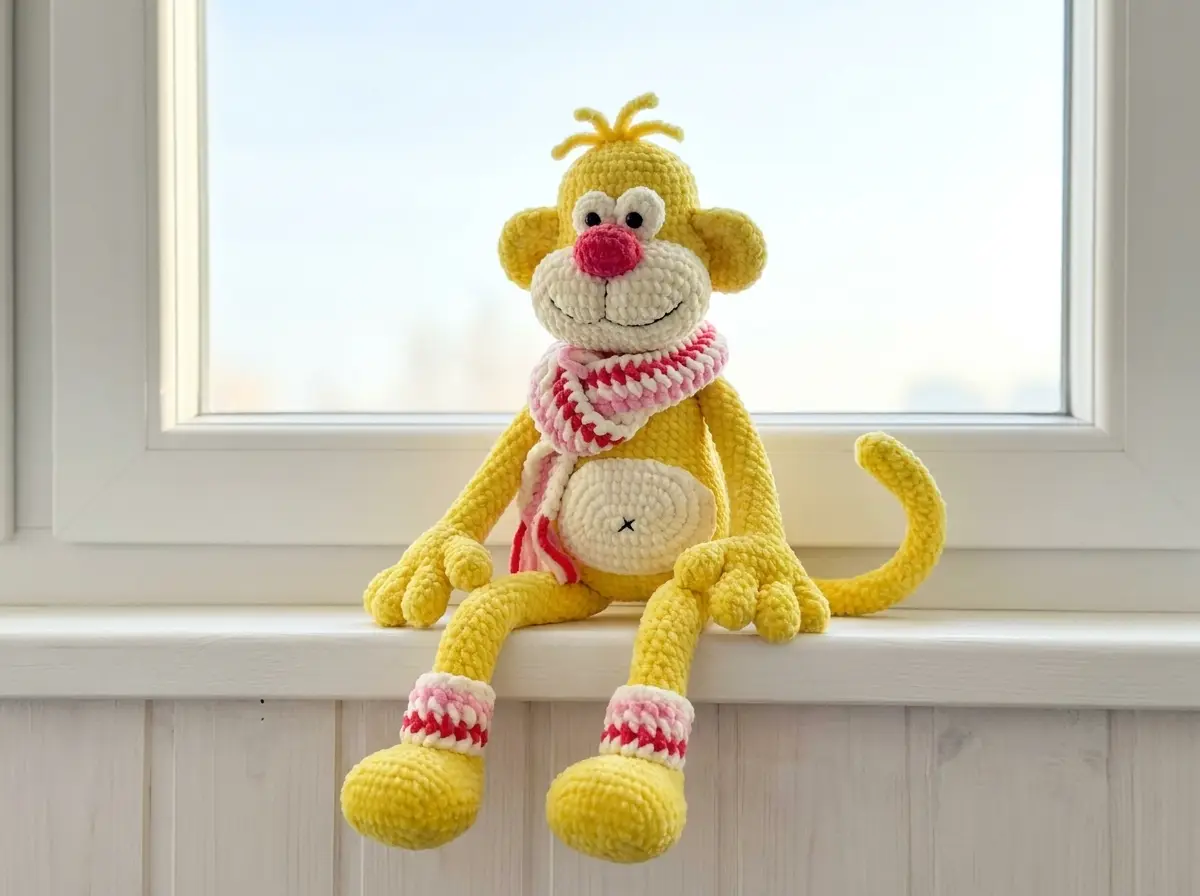
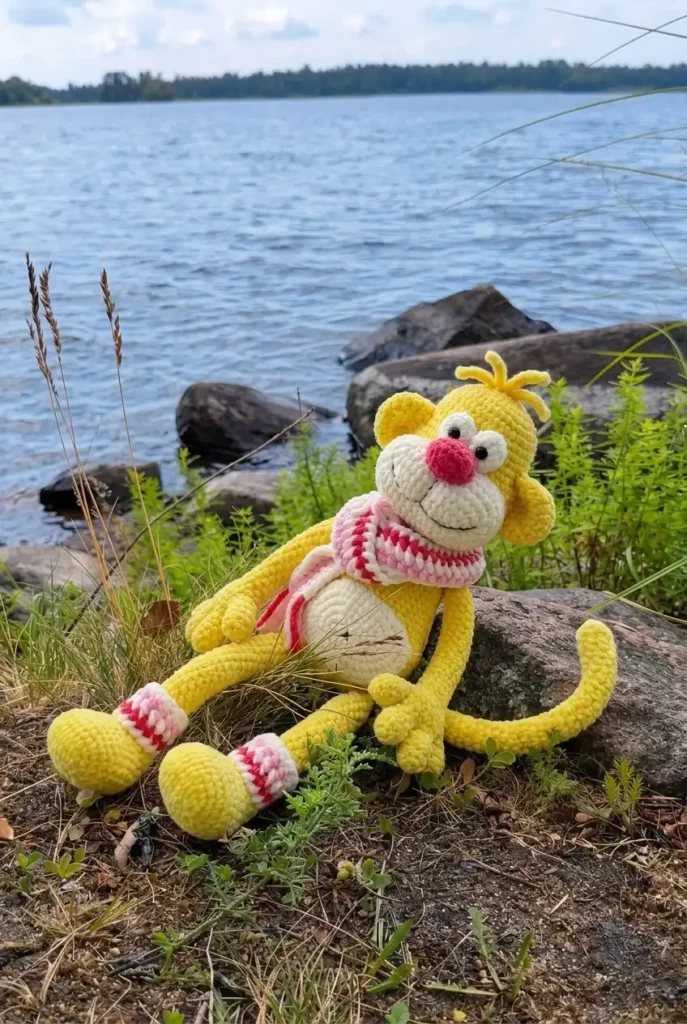
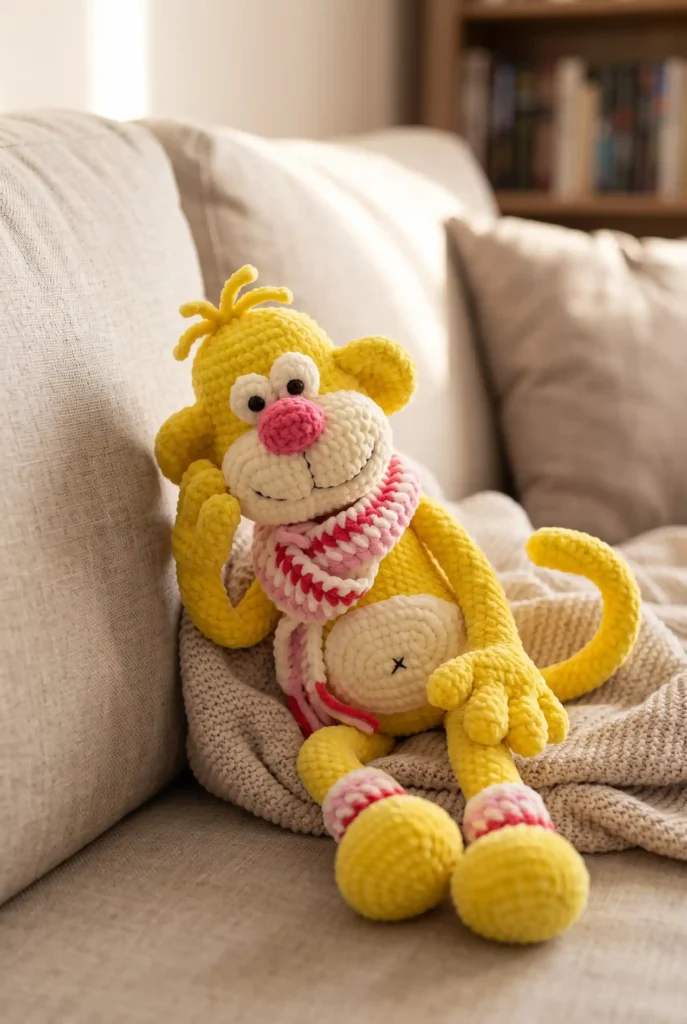
Long yellow limbs, a bright pink nose and a smile stitched into a soft white muzzle give this monkey its character. This monkey amigurumi free pattern builds the hands, feet and face as separate pieces, then brings them together around a shaped body and a long curved tail.
The small decisions matter most at assembly: the angle of the ears, the position of the muzzle and how the arms meet the body. The construction guide below keeps those decisions beside the relevant instructions, with quick links so you can return to the piece you are working on.
Materials US terms Hands & arms Feet & legs Body Tail Head Face pieces Ears & tummy Assembly FAQ
Draft pattern check: The hand construction, body joins and tail repeat in the available instructions need clarification. Notes at those passages explain the conflicts without guessing a replacement. Review those notes before buying yarn or starting the monkey.
Plan the pieces before you pick up your hook
- Prepare the arms before the upper body. The design joins the arms during body Round 22, so they are needed before that round.
- Make the feet, then the legs. Sew each foot to its leg before joining the two legs to begin the body. Keep the yarn attached to the second leg.
- Build the face separately. The head, muzzle, nose, two white eye pieces and two ears are made individually. The hair is worked directly into the head.
- Keep the finishing pieces together. Set aside the tail and white tummy panel for sewing. The scarf is an optional, unmeasured customization.
For pairs, place the first finished piece beside the second as you work. Compare their lengths and shaping at the same round, using the same yarn and hook. A difference in tension is easier to notice before the pieces are attached.
Choose your yarn and tools
- Yellow chenille or velvet yarn for the main pieces, plus compatible white yarn for the muzzle, eye pieces and tummy. The source does not identify a specific original yarn brand or label length.
- Bright pink yarn for the nose; light pink and white can be used for the optional striped scarf. Pink is also an optional hair accent.
- 3.25 mm crochet hook (US D-3). Follow the millimeter size when comparing hooks.
- Polyester fiberfill for stuffing.
- Two 6 mm black post-and-washer eyes or sew-on beads. These are different attachment methods; read the eye section before assembling the head.
- Tapestry needle, scissors and a stitch marker. A long, thin sewing needle and strong black thread are useful for the face and belly-button embroidery.
Chenille describes the yarn texture, not a single yarn weight. The original yarn and gauge are not specified here, so there is no verified substitute list or dependable finished-size target. Keep the main colors compatible and check that the fabric is dense enough to contain the stuffing without forcing an uncomfortable tension.
The Craft Yarn Council hook chart pairs 3.25 mm with D-3. A 3.0 mm or 3.5 mm hook changes the size; it is not another label for the same hook.
Eye hardware: Plastic eyes and beads are small parts. The name “safety eyes” does not establish that a finished toy is suitable for a young child. Keep toys with small parts away from children under 3, following the CPSC toy guidance.
US crochet terms and round notation
| Abbreviation | Meaning in this pattern |
|---|---|
| ch | Chain |
| sc | Single crochet |
| inc | 2 sc in the same stitch |
| dec | Decrease 2 stitches to 1 |
| sl st | Slip stitch |
| MR | Magic ring |
| 3-in-1 | 3 sc in the same stitch |
| st / sts | Stitch / stitches |
| Rnd / Rnds | Round / rounds |
| FO | Fasten off |
Use US terms throughout. A sequence followed by ×3 is worked three times in total. Numbers in parentheses are the stated end-of-round counts. When a range says “Rnds 5–7,” work the listed instruction in each of those three rounds. The Craft Yarn Council abbreviation list provides a standard reference.
Most circular sections are worked continuously. Move the marker to the first stitch of each new round; do not add joining slip stitches unless the instruction calls for one. The legs start with a chain joined into a ring, and the body ends with two rounds of slip stitches. See the continuous and joined rounds guide if these methods are unfamiliar.
Choose the right start: Fingers, tail and white eye pieces begin with a magic ring. Work the first-round stitches before drawing the ring closed. The head, feet, muzzle, nose, ears and tummy begin around a foundation chain to make an oval; the two sides of that chain are both used.
For single-crochet decreases, the supplied instructions use the front-loop invisible decrease: work through the front loops of the next two stitches to reduce them to one. The invisible decrease tutorial shows that technique. A “3-in-1” is different: it adds three single crochets to one base stitch.
Hands and arms — make two
Use yellow yarn. The fingers are made first, then joined into the hand and continued into a long arm. The individual finger rounds below are consistent; the later join needs the original construction instructions.
Individual fingers
Quantity needs confirmation: The available text says four fingers per hand, eight in total. It then uses all four in Round 6 and adds a thumb in Round 9. This does not establish whether each hand has four pieces total or four fingers plus a separate thumb.
Rnd 1: 6 sc in MR (6)
Rnd 2: (1 sc, inc) ×3 (9)
Rnds 3–5: 9 sc (3 rounds) (9)
For help with the finger start, use the magic ring tutorial. Keep the fingers together by hand so they are not mixed between the two sides.
Yarn ends at the join: The original preparation note keeps the yarn attached to the fourth finger and to each thumb, cutting it on the other fingers. Because the thumb is not clearly identified within the stated quantity, that preparation needs confirmation before cutting or joining.
Hand join and arm tube
Rnd 6: 2 sc across 3rd finger, 2 sc across 2nd finger, 9 sc across 1st finger, across 2nd finger: 6 sc, across 3rd finger: 6 sc, across 4th finger: 9 sc (34)
Missing transition after Round 6: The written join makes 34 stitches, but the next instruction gives only 14 single crochets. It also uses only eight of the nine stitches on each of fingers 2 and 3, without explaining those two unworked stitches. No decrease sequence, partial-round route or closure explains the change to 14. The next two rounds are retained exactly in substance; do not invent decreases to reach their stated count.
Rnd 7: 14 sc (14)
Rnd 8: 14 sc (14)
Rnd 9: 4 sc, 2 sc together with thumb: (1 sc, dec) ×2, 1 sc, 8 sc across arm (17)
Round 9 also needs clarification: Reading its operations consecutively gives 19 stitches, while the stated total is 17. Round 10 is written to consume 17. Changing only the printed total would leave the following round inconsistent.
Rnd 10: 6 sc, dec, 9 sc (16)
Rnd 11: (dec, 1 sc) ×4, 2 dec (10)
Rnds 12–33: 10 sc (22 rounds) (10)
The straight arm section is 22 rounds at 10 stitches per round. Once the hand construction is confirmed, make the second arm to match and keep both available for body Round 22.
Feet and legs — make two of each
Shape the feet
Use yellow yarn and begin with a foundation chain. The foot grows into an oval, holds its width for three rounds, then narrows toward the leg end.
Rnd 1: 10 ch, from 2nd ch: 8 sc, 3-in-1, 9 sc (20)
Foundation placement to confirm: Round 1 totals 20 stitches, but the instruction does not explain how the nine returning single crochets are distributed at the starting end of the chain. Keep the original wording here; a matching total alone does not establish the missing corner placement.
Rnd 2: inc, 7 sc, 3 inc, 7 sc, 2 inc (26)
Rnd 3: 1 sc, inc, 7 sc, (1 sc, inc) ×3, 7 sc, (1 sc, inc) ×2 (32)
Rnd 4: 14 sc, inc, 15 sc, inc, 1 sc (34)
Rnds 5–7: 34 sc (3 rounds) (34)
Width check: Rounds 5, 6 and 7 each have 34 stitches. They maintain the width rather than adding another increase round.
Rnd 8: 14 sc, dec, 15 sc, dec, 1 sc (32)
Rnd 9: (14 sc, dec) ×2 (30)
Rnd 10: (dec, 10 sc, dec, 1 sc) ×2 (26)
Rnd 11: (11 sc, dec) ×2 (24)
Rnd 12: (10 sc, dec) ×2 (22)
Rnd 13: (9 sc, dec) ×2 (20)
Rnd 14: (8 sc, dec) ×2 (18)
Rnd 15: 18 sc (18)
Rnd 16: (dec, 1 sc) ×6 (12)
Fasten off. Make the second foot with the same hook and yarn. The final foot opening has 12 stitches; the leg begins with 13 chains. Do not add a stitch to the foot solely to make those counts identical—the pieces are sewn together.
Work the long legs
Use yellow yarn. The first numbered entry below is a foundation ring of 13 chains, not a round of 13 single crochets.
Rnd 1: 13 ch joined into a ring (13)
Rnds 2–30: 13 sc (29 rounds) (13)
Keep the second leg attached to the yarn. It continues into the body. Sew each foot to the bottom of its leg before joining the legs. Set the pair together and check the feet face the intended direction before securing the seams.
Join the legs and shape the body
Continue in yellow from the second leg. The seven-chain bridge connects the legs; the body instructions work across each leg and both sides of the bridge.
Rnd 1: ch 7 and join to first leg: 3 sc, (1 sc, inc) ×3, 4 sc, across ch: 2 sc, inc, 1 sc, inc, 2 sc. Across leg: 4 sc, (inc, 1 sc) ×3, 3 sc, across other side of ch: 7 sc (48)
Rnd 2: across ch: 1 sc, inc, 3 sc, inc, 1 sc. Body: 3 sc, (2 sc, inc) ×3, 17 sc, (inc, 2 sc) ×3, 3 sc (56)
Check the round-start location: The arithmetic of these rounds gives 48, then 56 stitches. However, Round 1 ends along the second side of the bridge and Round 2 starts with an “across ch” segment. The available text does not specify a marker shift or explain that starting position; confirm the route rather than moving the marker by guesswork.
Rnds 3–7: 56 sc (5 rounds) (56)
Rnd 8: 5 sc, dec, 26 sc, dec, 21 sc (54)
Rnd 9: 54 sc (54)
Rnd 10: (7 sc, dec) ×6 (48)
Rnd 11: 48 sc (48)
Rnd 12: (6 sc, dec) ×6 (42)
Rnd 13: 3 sc, dec, (5 sc, dec) ×5, 2 sc (36)
Rnds 14–20: 36 sc (7 rounds) (36)
Shape check: The middle body narrows through 56, 54, 48, 42 and 36 stitches. Rounds 14–20 hold at 36 stitches for seven rounds. Keep those plain rounds distinct from the decrease rounds.
Rnd 21: (4 sc, dec) ×6 (30)
Have both completed arms at hand before the next round. They are incorporated during the crochet join rather than added as sewn pieces afterward.
Rnd 22: Along body: 3 sc, dec, 4 sc, dec (catching loop of arm and body). Along arm: 4 sc, dec. Along body: 3 sc, dec, 2 sc, dec, 3 sc. Along arm: dec, 4 sc, dec (catching loop of arm and body). Along body: 1 sc (31)
Arm-attachment route to confirm: Round 22 adds up to the stated 31 new stitches, but “catching loop of arm and body” does not fully identify the paired stitches or the underarm stitches left out of the route. A drawing or the original instruction is needed to complete this join reliably.
Rnd 23: 3 sc, dec, 26 sc (30)
Rnd 24: (dec, 3 sc) ×6 (24)
Rnd 25: 1 sc, (dec, 2 sc) ×5, dec, 1 sc (18)
Rnd 26: (dec, 1 sc) ×6 (12)
Rnds 27–28: 12 sl st (12)
The last two rounds are slip stitches. Keep Rounds 27–28 as 12 sl st each. They are not two more rounds of single crochet, and the 12-stitch neck is the opening used when the head is attached.
Stuff the body and fasten off. For easier access, add fiberfill gradually while the opening is wide, then adjust before it narrows. Check the outline from the front and sides; add small amounts rather than forcing in one large clump. The source does not provide a complete stuffing plan for every limb and small part.
Make the curved tail
Use yellow yarn and a magic ring. The shaping rounds place an increase and a decrease at different positions while keeping the circumference at 10 stitches. Do not replace them with plain rounds just because the totals stay the same.
Rnd 1: 6 sc in MR (6)
Rnd 2: (1 sc, inc) ×3 (9)
Rnd 3: 6 sc, inc, 2 sc (10)
Rnd 4: 10 sc (10)
Rnd 5: 2 sc, dec, 3 sc, inc, 2 sc (10)
Repeat length to confirm: The next line names Rounds 6–33, a span of 28 rounds, but asks for fifteen two-round repeats, which would take 30 rounds. Fourteen repeats fit the labels; fifteen would extend through Round 35. The intended length is not established, so neither option is silently chosen here.
Rnds 6–33: Repeat rounds 4–5 fifteen times (10)
Rnd 34: 10 sc (10)
Rnd 35: 3 sc, inc, 3 sc, dec, 1 sc (10)
After Round 35, the text asks for twelve more repeats of Rounds 34–35, then fastening off. Those repeats add 24 rounds. Their final numbering depends on resolving the earlier repeat conflict; the tail instructions do not specify wire or an armature.
Head and worked-on hair
Use yellow yarn. This head begins as an oval around a chain, not a magic ring. The explicit increase at the returning end of Round 1 helps distribute the stitches around the second corner.
Rnd 1: 11 ch, from 2nd ch: 9 sc, 3-in-1, along 2nd side: 8 sc, inc (22)
Rnd 2: inc, 8 sc, 3 inc, 8 sc, 2 inc (28)
Rnd 3: 1 sc, inc, 8 sc, (1 sc, inc) ×3, 8 sc, (1 sc, inc) ×2 (34)
Rnd 4: 2 sc, inc, 8 sc, (2 sc, inc) ×3, 8 sc, (2 sc, inc) ×2 (40)
Rnds 5–16: 40 sc (12 rounds) (40)
Keep the center section even: Rounds 5–16 are twelve rounds of 40 sc each. Mark the first and last round of that straight section so it is not shortened when counting from the oval base.
Rnd 17: 2 sc, dec, 8 sc, (2 sc, dec) ×3, 8 sc, (2 sc, dec) ×2 (34)
Rnd 18: 1 sc, dec, 8 sc, (1 sc, dec) ×3, 8 sc, (1 sc, dec) ×2 (28)
Rnd 19: dec, 8 sc, 3 dec, 8 sc, 2 dec (22)
Stuff the head and fasten off. Fastening off ends the working yarn; it does not mean the opening must immediately be sewn shut. Keep access for the chosen eye attachment and for sewing the head to the body.
Three hair passes
Join yellow yarn directly to the top of the head, or use pink as an accent. Each pass makes a chain strand, works back along it and anchors into the next head stitch.
Pass 1: 8 ch, from 2nd ch: 1 sc, 6 sl st, sl st into next head stitch
Pass 2: 10 ch, from 2nd ch: 2 sc, 7 sl st, sl st into next head stitch
Pass 3: 8 ch, from 2nd ch: 1 sc, 6 sl st, sl st into next head stitch
The final slip stitch in each pass goes into the head, after the chain strand has been worked. Fasten off and weave in the ends once the three passes are anchored.
Make the muzzle, nose and eye pieces
Lay out the white muzzle, pink nose and both white eye pieces on the head before sewing them permanently. The muzzle is the largest face piece, so position it first and compare the eyes against its upper edge.
White muzzle
Rnd 1: 14 ch, from 2nd ch: 12 sc, 3-in-1, along 2nd side: 13 sc (28)
Foundation placement to confirm: The 28-stitch total is consistent, but the return-side “13 sc” does not specify how the stitches turn the starting corner. The original placement needs confirmation before this foundation is expanded.
Rnd 2: inc, 11 sc, 3 inc, 11 sc, 2 inc (34)
Rnd 3: 1 sc, inc, 11 sc, (1 sc, inc) ×3, 11 sc, (1 sc, inc) ×2 (40)
Rnd 4: 2 sc, inc, 11 sc, (2 sc, inc) ×3, 11 sc, (2 sc, inc) ×2 (46)
Rnd 5: 2 sc, inc, 11 sc, (3 sc, inc) ×3, 11 sc, (3 sc, inc) ×2, 1 sc (52)
Rnd 6: 2 sc, inc, 11 sc, (4 sc, inc) ×3, 11 sc, (4 sc, inc) ×2, 2 sc (58)
Rnd 7: 58 sc (58)
Rnd 8: (1 sc, dec) ×2, 14 sc, (1 sc, dec) ×5, 14 sc, (1 sc, dec) ×3 (48)
Rnd 9: 2 dec, 14 sc, 5 dec, 14 sc, 3 dec (38)
Rnd 10: 2 dec, 9 sc, 5 dec, 9 sc, 3 dec (28)
Fasten off. Keep enough yarn for attachment. Check the orientation against the head before sewing; the instructions do not supply exact attachment rounds or measured eye spacing.
Pink nose
Rnd 1: 5 ch, from 2nd ch: 3 sc, 3-in-1, along 2nd side: 4 sc (10)
Foundation placement to confirm: Round 1 totals 10 stitches, but the returning four sc need a clearer corner route. Do not substitute a different oval foundation solely because it gives the same number.
Rnd 2: inc, 2 sc, 3 inc, 2 sc, 2 inc (16)
Rnd 3: 16 sc (16)
Rnd 4: dec, 2 sc, 3 dec, 2 sc, 2 dec (10)
Position the nose on the front of the muzzle, near its upper edge, and sew it on after checking the face layout.
White eye pieces — make two
Rnd 1: 6 sc in MR (6)
Rnd 2: 6 inc (12)
Rnd 3: 12 sc (12)
Rnd 4: 6 dec (6)
Fasten off. The supplied assembly method passes each black eye post through its white crochet piece and then through the head, with the backing secured inside the head while that area is still accessible. Follow the hardware instructions for the actual eyes you use. Sew-on beads are attached with thread; they do not use locking washers.
Ears and white tummy panel
Yellow ears — make two
Rnd 1: 8 ch, from 2nd ch: 6 sc, 3-in-1, along 2nd side: 5 sc, inc (16)
Rnd 2: inc, 5 sc, 3 inc, 5 sc, 2 inc (22)
Rnds 3–6: 22 sc (4 rounds) (22)
Leave long sewing tails and do not stuff the ears. Flatten them slightly when positioning. Compare their height on the two sides of the head from the front before attaching either one permanently.
White tummy — make one
Rnd 1: 8 ch, from 2nd ch: 6 sc, 3-in-1, along 2nd side: 5 sc, inc (16)
Rnd 2: inc, 5 sc, 3 inc, 5 sc, 2 inc (22)
Rnd 3: 2 inc, 5 sc, 6 inc, 5 sc, 4 inc (34)
Rnd 4: 1 sc, inc, 9 sc, (1 sc, inc) ×4, 9 sc, (1 sc, inc) ×3 (42)
Rnd 5: 2 sc, inc, 9 sc, (2 sc, inc) ×4, 9 sc, (2 sc, inc) ×3 (50)
Fasten off, leaving a long sewing tail. Round 3 has more increases than the surrounding rounds: the written increases move the count from 22 to 34 stitches. Check this round separately before working the larger final oval.
Arrange the face, then assemble
Set the pieces in position before committing to the seams. Use temporary pins or removable markers, check the front view, and remove every pin before the toy is finished. This is also the point to confirm access for eye backings before closing the head.
- Place the muzzle on the lower front of the head. Center it visually. Position the nose near the upper edge of the muzzle and the white eye pieces above it, then check the whole expression before sewing.
- Fit the chosen eye hardware while access remains. Follow the post-and-washer or sew-on method appropriate to the actual eyes; do not combine the two methods. Sew the white crochet pieces onto the head as needed.
- Attach the ears. Place them on the upper sides of the head, at eye level or slightly above, and compare the two sides.
- Sew the head to the neck. The head ends at 22 stitches and the neck at 12. These are different circumferences; the source does not give a stitch-for-stitch seam map. Position first rather than assuming each head stitch matches one neck stitch.
- Center the white tummy on the body. Check its position relative to the legs before sewing around it.
- Sew the tail to the lower back. Position it with a slight upward angle. The arms should already have been joined during body Round 22 once that route is clarified.
Keep sewing tails until their corresponding parts have been attached. The fastening-off guide explains ending the working yarn and handling the final tail; it does not replace the missing join instructions noted above.
Add the expression and optional scarf
Mouth: Use strong black thread and a long thin needle to embroider a small curve or V on the white muzzle. Position the mouth relative to the nose and check the front view as you work, keeping the tension gentle enough to avoid dragging the muzzle out of shape.
Belly button: Embroider a small black cross in the center of the tummy panel.
Optional scarf: Chain to your chosen width, then work single crochet in rows to a length that wraps around the neck with ends hanging down the front. Change between pink and white every two rows, fasten off and weave in the ends. This is a customization suggestion, not a measured accessory pattern.
About the reference photo: The striped ankle cuffs have no instructions in the supplied pattern. The general rectangular scarf suggestion also does not reproduce every detail of the photographed neckwear. Use the image for color and styling inspiration, not as proof that every accessory is included.
Which colors would you choose for the monkey and scarf? Share your combination in the comments. If you are checking a stitch count, include the piece name, round number and count you reached so the question is specific.
Questions about this monkey pattern
Why do some pieces start with a chain instead of a magic ring?
The head, feet, muzzle, nose, ears and tummy use oval foundations worked around both sides of a chain. The fingers, tail and white eye pieces start with a magic ring. The legs use a third arrangement: a chain joined into a ring. These starts are not interchangeable without changing the construction.
Is 3-in-1 the same as an increase?
No. In this pattern, inc means two single crochets in the same stitch. A 3-in-1 means three single crochets in the same stitch. Working those three stitches into separate base stitches would change the oval shaping.
Are the arms sewn on after the body is finished?
The design joins the arms while crocheting body Round 22, so the arms need to be ready before that round. The available joining instruction is incomplete about the shared and underarm stitches; it needs clarification rather than a guessed sewing or crochet route.
When should I attach post-and-washer eyes?
Fit the backings while you can still reach the inside, before sewing the head assembly closed. Arrange the muzzle and white eye pieces first to judge the expression, then follow the hardware instructions. Sew-on beads use a different method, and the name safety eyes does not establish suitability for young children.
How can I keep the muzzle centered while sewing?
Position the muzzle, nose and both eye pieces together first. Check the front view and temporarily hold the muzzle in place before sewing around it. The pattern gives no exact attachment rounds or measured spacing, so do not use an invented stitch-distance rule to place the face.
Does this include the exact scarf and striped ankle cuffs in the photo?
No. The text includes a general striped-rectangle scarf suggestion with a chosen width and length, but no measured scarf or cuff pattern. The photographed accessories are styling references; their complete instructions are not supplied here.