Best Yarn for Amigurumi: A Complete Beginner’s Guide
The best yarn for amigurumi is smooth, tightly plied, and dense enough to hide polyfill stuffing without gaps. This guide covers fiber type, yarn weight, hook size, and US-available brand recommendations so you can buy with confidence and start your first project without second-guessing every skein. By the end, you will know exactly what to put in your cart.
I spent years watching students ruin beautiful projects with the wrong yarn — fuzzy halos hiding every stitch, cheap acrylic sagging under stuffing weight, colors bleeding onto each other mid-project. The yarn decision looks simple. It is not. Get it right from the start and everything else clicks into place. This guide is what I wish existed when I began.
If you are brand new to amigurumi, I recommend reading the complete beginner’s guide to amigurumi first — it will give you the full foundation this article builds on.
What Makes a Yarn Good for Amigurumi?
A great amigurumi yarn delivers three things without compromise: sharp stitch definition so every single crochet reads cleanly, enough fiber density to block stuffing from showing through, and structural stability that keeps the finished piece holding its shape for years. Any yarn missing one of these three qualities will cost you a finished project.
Stitch Definition: Why It Matters More Than You Think
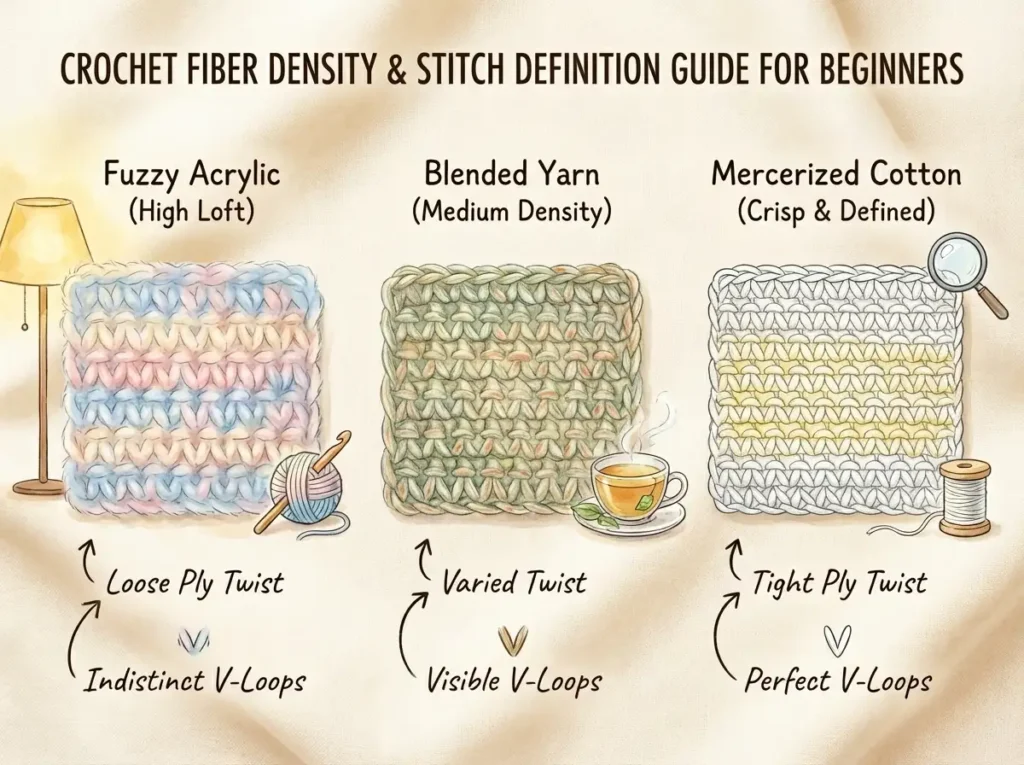
Amigurumi is built almost entirely on the single crochet stitch worked in continuous rounds. That means the visual quality of your finished piece depends entirely on how cleanly each stitch presents. A yarn with poor stitch definition — anything brushed, loosely spun, or heavily textured — will blur the surface of your work into an indistinct mass. You lose the satisfying V-shape of each stitch, and the overall silhouette looks fuzzy and unintentional.
Smooth, tightly plied yarns give you the crispest stitch definition. Mercerized cotton is the gold standard here. The mercerization process adds a slight sheen and compresses the fiber, creating a surface that shows every loop with almost photographic clarity. When I work in fine mercerized cotton on a 2.5mm (approx. US C/2) hook, I can see every stitch perfectly — and so can everyone else.
Emma’s experience shows that even a slight upgrade in yarn smoothness — moving from a loosely spun acrylic to a tightly plied one — can transform a mediocre-looking amigurumi into something that looks professionally made. The stitch definition difference is visible from across a room.
Fiber Density and Hiding Polyfill
Stuffing showing through the finished fabric is one of the most common complaints I hear from beginners. You can see white polyfill peeking through the body of a dark-colored piece, or the entire surface looks uneven and lumpy because the fabric is too loose. This is a yarn problem before it is a tension problem.
Denser fibers — specifically tightly plied cotton and high-twist acrylic — create a fabric with smaller physical gaps between stitches, even before you tighten your tension. When you pair a dense fiber with tight tension and a slightly undersized hook, the resulting fabric is nearly opaque. You can press your fingers against the back of the swatch and see almost nothing through it. That is the standard you are working toward.
Polyfill, specifically Poly-Fil by Fairfield available at Joann, Michaels, and Hobby Lobby, expands after insertion. A fabric that looks borderline acceptable before stuffing will look clearly inadequate after. Always test density before committing to a full project.
Durability and Shape Retention Over Time
Amigurumi pieces are handled. They are gifted to children, squeezed, washed, and loved hard. A yarn that cannot hold its shape under repeated use will produce a finished piece that looks deflated and sad within months. The fiber needs to have enough elasticity or structural integrity to spring back after compression.
Cotton holds its shape beautifully but has very low elasticity — it does not stretch and return, it simply resists deformation. Acrylic has a small amount of stretch that can work in its favor for handled pieces. After testing dozens of yarn types across long-term projects, I have found that tightly plied acrylic in worsted or DK weight holds up best for pieces intended for children, while mercerized cotton is ideal for display pieces and collector-quality work.
Best Yarn Weight for Amigurumi (And Why Most Guides Get This Wrong)
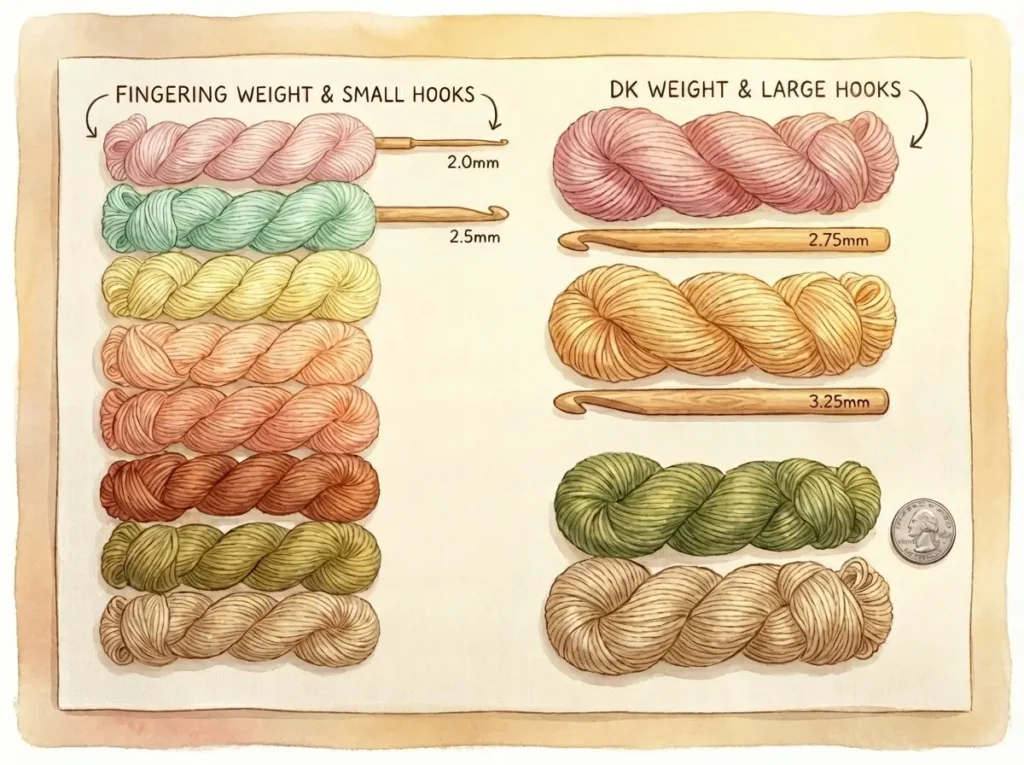
Fingering weight and DK weight are the two dominant choices for amigurumi, with fingering producing the finest detail and DK offering a beginner-friendly balance of speed and definition. Worsted weight works for large beginner projects but sacrifices stitch clarity at smaller scales.
Fingering Weight: Maximum Stitch Definition, Smallest Scale
Fingering weight yarn — CYCA weight 1 — is my personal choice for every amigurumi I design. Paired with a 2.5mm (approx. US C/2) hook, fingering weight mercerized cotton produces the tightest, most defined fabric possible. Each stitch is a precise, clean V. The finished pieces are small in scale but visually extraordinary — you can see every increase and invisible decrease row perfectly mapped across the surface.
The tradeoff is real: fingering weight is slower to work than heavier yarns, and it demands consistent tight tension. Your hands will feel it on long projects. But if you are aiming for professional-quality amigurumi that photographs beautifully and impresses even experienced crocheters, fingering weight is the path. I work with it exclusively, hand cramps and all.
Common fingering weight options available in the US include Paintbox Simply Fingering and various mercerized cotton sock yarns available at LoveCrafts and KnitPicks.
DK Weight: The Beginner Sweet Spot
DK weight — CYCA weight 3 — is where I send most beginners who are frustrated and close to quitting. It is not a compromise. A smooth, tightly plied DK worked on a 3.25mm (US D/3) hook produces excellent stitch definition and finishes a project fast enough to stay motivating. The stitches are large enough to see and count clearly without magnification.
Paintbox Simply DK is one of the most reliable options in this category for US crafters. It is widely available through LoveCrafts, maintains consistent twist across colorways, and produces a beautifully even fabric in continuous rounds. The color range is excellent for character design work.
For a first amigurumi — a simple round body, a head, basic limbs — DK weight will carry you through successfully without the tension demands of fingering weight. Master your gauge here first, then move to finer weights as your hands develop muscle memory.
Worsted Weight: Fast Results, Lower Detail
Worsted weight — CYCA weight 4 — is the most beginner-accessible weight category at US craft stores, and it shows up in nearly every beginner tutorial online. For very large amigurumi — think oversized stuffed animals meant to be decorative rather than precision-crafted — worsted gets the job done quickly. Lion Brand Pound of Love is the workhorse choice here: machine washable, widely available at Michaels and Joann, and sold in large enough skeins to finish most large projects without a dye lot issue.
The limitation is detail loss. At worsted weight, individual stitches are large enough that shape changes — increases, invisible decreases, shaping rows — show as visible transitions rather than seamless curves. The amigurumi gauge tightens relative to standard patterns, but you are still working at a scale where fine features like ear shaping and face contouring look blocky. Use worsted weight to learn the mechanics, then transition to DK or fingering as your ambitions grow.
Best Yarn Fiber for Amigurumi: Cotton vs Acrylic vs Blends
Mercerized cotton produces the sharpest stitch definition and the firmest finished fabric of any fiber category, making it the professional standard for display-quality amigurumi. Acrylic is forgiving, widely available at US craft stores, and machine washable — the practical starting point for most beginners. Cotton-acrylic blends occupy a useful middle ground between definition and ease of handling.
Mercerized Cotton: The Professional Standard
Mercerized cotton is cotton yarn that has been treated under tension with a sodium hydroxide solution, causing the fibers to swell and straighten. The result is a yarn with increased luster, dramatically improved dye uptake — meaning your colors stay true and vivid — and a tight, smooth surface that produces exceptional stitch definition. It does not pill. It does not stretch out of shape. It photographs beautifully.
The handling characteristics take adjustment. Cotton has zero elasticity, which means your tension must be consistent from the very first stitch because you cannot rely on any fiber memory to even things out. It is also heavier than acrylic at equivalent yardage, so your hands tire more quickly on long sessions. I manage this by working in focused intervals — 45 minutes on, a break, repeat.
For amigurumi intended as gifts, display pieces, or collector-quality work, mercerized cotton is the only fiber I use. The finished surface clarity is simply not replicable in any other fiber category.
Acrylic Yarn: Why Beginners Reach for It First
Acrylic yarn is machine washable, color-consistent across large dye lots, sold at every US craft store, and available at price points that make frogging a wrong-gauge project emotionally painless. These are real advantages, especially when you are still learning to manage tension and make inevitable mistakes. A skein of worsted acrylic from Michaels is not a significant financial loss if you need to restart.
The limitation of acrylic is pilling. High-traffic surfaces — the bottom of a figure, areas that get squeezed repeatedly — will develop fiber pills over time, particularly on lower-quality acrylics. This is less of an issue for display pieces and more significant for toys that get daily handling. Lion Brand Pound of Love pills less than many budget acrylics and remains one of the most reliable US-available options for child-safe amigurumi.
Acrylic also has a slight halo on some spun varieties that can obscure stitch definition. Always check the twist before buying — tightly plied acrylics perform dramatically better than loosely spun ones in amigurumi applications.
Cotton-Acrylic Blends: A Practical Compromise
A yarn blending cotton and acrylic — typically in a 50/50 ratio — picks up meaningful strengths from both fibers. You get more stitch definition than pure acrylic offers, better machine-washability than pure cotton provides, and a slightly more forgiving tension feel than working with 100% cotton. For beginners who want to work up in fiber quality without the full demands of mercerized cotton, a blend is a sensible intermediate step.
Emma’s experience shows that blends vary enormously in quality depending on the twist and ply construction — a tightly plied cotton-acrylic blend can outperform a loosely spun pure cotton for amigurumi purposes. Read the label, check the twist by feel, and test stitch definition on a small swatch before committing to a full project.
Best Yarn for Amigurumi: Top Brand Recommendations
The brands listed below are US-available, tested for consistent twist and stitch definition, and purchasable at Joann, Michaels, Hobby Lobby, Amazon US, KnitPicks, or LoveCrafts. Every recommendation here is organized by fiber type so you can match your starting point to your skill level and budget.
Before you buy, make sure you have the essential amigurumi tools and supplies already assembled — your tapestry needle, stitch markers, and safety eyes should be ready before your yarn arrives.
Best Cotton Yarns for Amigurumi
- Paintbox Simply Fingering (100% cotton, fingering weight): Consistent twist, excellent stitch definition, wide color range. Pair with a 2.5mm (approx. US C/2) hook. Available through LoveCrafts with US shipping.
- DMC Natura Just Cotton (100% mercerized cotton, fingering weight): One of the finest stitch-definition options available. Works beautifully at 2.0–2.5mm (approx. US B/1–C/2). Available on Amazon US and specialty craft retailers.
- Paintbox Simply DK (100% cotton, DK weight): The most reliable beginner cotton option. Consistent twist, smooth feed, and a color palette specifically designed for character and figure work.
Best Acrylic Yarns for Amigurumi
- Lion Brand Pound of Love (100% acrylic, worsted weight): Machine washable, baby-safe, sold at Michaels and Joann in a massive colorway selection. Best for large beginner pieces. Pairs with a 3.75mm–4.0mm (approx. US F/5–G/6) hook.
- Red Heart Soft (100% acrylic, worsted weight): Lower pill tendency than many worsted acrylics. Good drape for larger figures. Available at Walmart, Michaels, and Joann.
- Paintbox Simply DK Acrylic (100% acrylic, DK weight): Tight plying makes this one of the best acrylic options for stitch definition at DK weight. Pairs with a 3.25mm (approx. US D/3) hook.
Yarns to Avoid (And Exactly Why)
- Any brushed or mohair-blend yarn: The halo completely obscures stitch definition. You cannot see your increases, decreases, or shaping rows. The finished piece looks like a fuzzy blob rather than a structured figure.
- Loosely spun bulky yarn: The gaps between plies are large enough that stuffing shows through even with tight tension. The scale is also too large for any detail work.
- Novelty or textured yarns: Boucle, velvet, chenille, and similar novelty constructions are not compatible with amigurumi. You cannot read your stitches, count rounds, or place safety eyes accurately through the texture.
- Very cheap unlabeled acrylic: Inconsistent twist leads to inconsistent tension. The finished surface will look uneven even when your technique is correct.
Hook Size, Gauge, and How Your Yarn Choice Affects Both
Your yarn weight determines the starting range for hook size selection, and your gauge — the number of stitches per inch in your finished fabric — determines whether your amigurumi will hold stuffing cleanly or show gaps. Amigurumi gauge is always tighter than the standard gauge listed on a yarn label.
For a full breakdown of hook selection by project type, see my guide on choosing the right hook size for your yarn — it covers every weight category with specific pairing recommendations.
Matching Hook Size to Yarn Weight
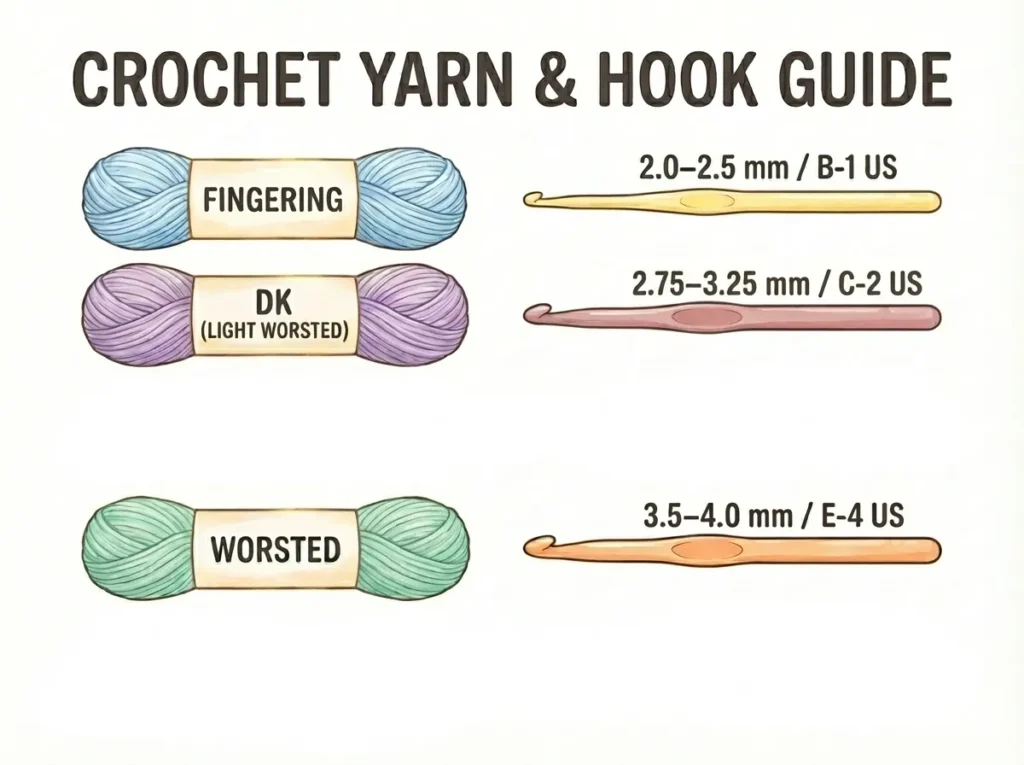
The hook size printed on a yarn label is the recommended size for producing a fabric with standard drape — appropriate for garments, blankets, and accessories. Amigurumi is not any of those things. Amigurumi requires a dense, structured fabric, which means you use a hook one to two sizes smaller than the label recommends.
- Fingering weight (CYCA 1): Label recommends 1.5–2.25mm. Use 2.0–2.5mm (approx. US B/1–C/2) for amigurumi.
- DK weight (CYCA 3): Label recommends 3.25–3.75mm. Use 2.75–3.25mm (approx. US C/2–D/3) for amigurumi.
- Worsted weight (CYCA 4): Label recommends 4.5–5.5mm. Use 3.5–4.0mm (approx. US E/4–G/6) for amigurumi.
Why Amigurumi Gauge Is Tighter Than Standard Gauge
Standard gauge exists to produce fabric with a specific drape and hand feel. Amigurumi gauge exists to produce fabric that functions as a structural shell — dense enough to hold stuffing without deformation, firm enough to maintain a sculpted shape under handling. These are completely different functional goals.
A standard worsted gauge might be 14 stitches over 4 inches. An amigurumi worsted gauge might be 18–20 stitches over 4 inches using the same yarn. That difference represents a significantly denser fabric with smaller physical gaps between stitches. This is exactly what prevents stuffing from showing through, and it is why you always go down in hook size for amigurumi work.
Emma’s Pro Tip: I always test gauge on a flat swatch before starting any amigurumi body, even when I know the yarn. Fine mercerized cotton on my 2.5mm (approx. US C/2) hook reads consistently at 22 stitches and 24 rows over 4 inches — that is my personal baseline. If your swatch is looser, go down half a millimeter before committing to the full project. No exceptions.
How to Test Your Gauge Before Starting
Chain 16 stitches. Work single crochet back and forth for 16 rows. Do not join into a round — a flat swatch is faster and gives you accurate row data. Fasten off, lay flat without stretching, and count stitches across a 4-inch span in the middle of the swatch. Count rows over a 4-inch vertical span. Compare to your pattern’s stated gauge.
If you have too few stitches per inch, your tension is too loose — go down in hook size or tighten your grip. If you have too many stitches per inch, your tension is too tight — go up in hook size. Gauge testing takes 15 minutes and prevents hours of frogging later.
Common Yarn Mistakes Amigurumi Beginners Make
The three most damaging beginner yarn errors are choosing fuzzy or textured fiber that hides stitch definition, ignoring yarn pilling on pieces that will be handled regularly, and skipping colorfastness testing before working with saturated or dark hues. Each of these mistakes results in a finished piece that does not look or hold up the way you intended.
Managing these problems starts with understanding how tension affects your finished piece — tight, consistent tension amplifies the quality of good yarn and partially compensates for a mediocre one.
Choosing Fuzzy or Textured Yarn
This is the single most common yarn mistake I see from beginners, and it is understandable — fuzzy yarn looks soft and appealing on the skein. The problem becomes obvious the moment you start working with it. You cannot see your stitches clearly enough to count rounds, identify where to insert your hook, or place your safety eyes accurately. By round six you are guessing.
The finished piece looks undefined and shapeless. The careful shaping built into your pattern — all those increase and invisible decrease rows — disappears under the halo. If you want texture in your finished piece, achieve it through yarn color choices and surface embellishment, not fiber construction.
Ignoring Yarn Pilling on Handled Pieces
Pilling happens when loose fiber ends on the yarn surface tangle together under friction. On a display piece that sits on a shelf, this is rarely an issue. On an amigurumi toy that gets carried, squeezed, and washed repeatedly, pilling degrades the surface quality within weeks on lower-quality yarns.
Test pilling tendency before you commit: rub a length of yarn against itself vigorously for 30 seconds. If pills form immediately, that yarn is not appropriate for a handled piece. Tightly plied acrylics and mercerized cotton resist pilling far better than loosely spun alternatives. Lion Brand Pound of Love performs well in this test for a worsted acrylic at its price point.
Color Bleeding and Colorfastness Testing
Color bleeding is most problematic in dark and highly saturated colorways — deep reds, navy blues, true blacks. When a figure combines a dark-colored body with light-colored limbs or face details, bleeding from the dark yarn can stain the light yarn during blocking or washing. The result is irreversible.
Test before you commit: wet a strand of your yarn and press it firmly against a white paper towel for 30 seconds. If the towel picks up significant color, that yarn will bleed. Wash the skein separately in cool water before working with it, or choose a different colorway. Mercerized cotton, due to the improved dye uptake from the mercerization process, typically bleeds less than untreated cotton or some budget acrylics in equivalent deep colorways.
How Much Yarn Do You Need for an Amigurumi Project?
Small amigurumi figures — palm-sized to fist-sized — typically use 50–100 yards of fingering weight or 75–150 yards of DK weight for the main body and head combined. Larger pieces or multi-color designs require 200 yards or more. Always buy more than the pattern calls for.
Estimating Yardage by Project Size
Pattern yardage estimates assume average tension and average stitch count — neither of which describes any real crocheter precisely. Tight tension uses more yarn per stitch than average. Additional surface features — ears, tails, fins, horns — each add yardage. Use pattern estimates as a floor, not a ceiling.
A rough guide for planning purposes:
- Mini amigurumi (under 3 in finished): 30–60 yds fingering weight
- Small figure (3–5 in finished): 75–150 yds DK weight, 50–100 yds fingering weight
- Medium figure (5–8 in finished): 150–250 yds DK weight, 100–175 yds fingering weight
- Large figure (8 in and above): 250+ yds worsted or DK weight
How to Avoid Running Out Mid-Project
Running out of yarn mid-project is painful in a way that is entirely preventable. Buy one full skein more than you calculate you need. If the finished project uses less, you have leftover yarn for small accent pieces. If you encounter tension variations, add surface embellishments, or need to frog and restart a section, you have coverage.
Weigh your yarn at the start of the project and at the halfway point. A digital kitchen scale accurate to one gram is sufficient. If you have used more than half your yarn before reaching the halfway point in the pattern, buy an additional skein before continuing. This is a faster resolution than discovering the shortage when your last 10 yards disappear into the closing round.
Buying Extra: The Dye Lot Problem
Dye lot numbers matter enormously in amigurumi. Two skeins of the same colorway produced in different dye lots can vary visibly in color temperature — one may read slightly warmer, the other cooler. In a garment you can hide this in a seam. In a single-color amigurumi body, a dye lot switch mid-project creates a visible ring around the piece that cannot be fixed without frogging.
Always buy all skeins for a project at the same time from the same retail batch. Check that dye lot numbers match on every skein before purchase. If you need to return for a second skein later, buy two — the lot may have changed, and having extra is always the safer position.
Frequently Asked Questions
Is cotton or acrylic better for amigurumi beginners?
Acrylic is the more forgiving starting point for most beginners. It is inexpensive, widely available at US craft stores, machine washable, and consistent across large dye lots. Once you have developed stable tension and feel comfortable with continuous rounds and invisible decreases, transitioning to mercerized cotton will produce noticeably sharper stitch definition and a more professional finish.
What weight yarn is best for small amigurumi?
Fingering weight — CYCA weight 1 — produces the finest detail and is the correct choice for small-scale amigurumi under 4 inches finished. Pair it with a 2.0–2.5mm (approx. US B/1–C/2) hook and maintain tight tension. DK weight is acceptable for small pieces if you prefer a faster working speed, but stitch definition will be coarser at equivalent finished sizes.
Can I use regular sewing thread or embroidery floss for amigurumi?
Embroidery floss is occasionally used for extremely miniature amigurumi worked on 0.9–1.5mm hooks, but it is not appropriate for standard-scale projects. Standard sewing thread is too fine and has insufficient structure for any crocheted fabric. Stick with yarn sized CYCA 1 or above and matched appropriately to your hook size for predictable results.
Why does stuffing show through my amigurumi even with tight tension?
Stuffing visibility is most often a yarn density problem before it is a tension problem. Loosely spun yarn, yarn with low ply count, or bulky yarn creates a fabric with larger physical gaps regardless of tension. Switch to a tightly plied smooth yarn — mercerized cotton or a high-twist acrylic — and go down one hook size from your current choice. That combination will close the gaps.
Ready to take your next step? Learn about choosing the right hook size for your yarn and build on what you just mastered.